Author: Editor

  • Integrating Technology with Religious Beliefs

    Integrating Technology with Religious Beliefs

    Modern Perspectives on Faith and Spirituality

    In the digital age, our understanding of faith and spirituality has evolved, as individuals and communities around the world have found new ways to explore and express their beliefs. The internet and social media have given rise to an unprecedented diversity of voices and perspectives on religious matters, enabling more inclusive and engaging conversations about faith.

    • Interfaith dialogue and understanding: The digital world has facilitated a greater exchange of ideas and perspectives among individuals from different religious backgrounds. Online platforms such as ‘Interfaith Voices’ (https://www.interfaithradio.org/) and ‘Patheos’ (https://www.patheos.com/) provide spaces for individuals to engage in interfaith dialogue, fostering understanding and respect among diverse faith communities.
    • Spiritual but not religious: The digital age has also given rise to a growing number of individuals who identify as “spiritual but not religious” (SBNR), who seek meaning and connection outside of traditional religious institutions. Websites like ‘Spirituality & Practice’ (https://www.spiritualityandpractice.com/) and ‘The Chopra Center’ (https://chopra.com/) offer resources and guidance for those exploring alternative spiritual paths.

    Integrating Technology with Religious Beliefs

    The integration of technology with religious beliefs has become increasingly common, as individuals and communities seek to harness the power of digital tools and platforms to deepen their connection with the divine and enhance their spiritual lives.

    • Prayer and meditation apps: As previously mentioned, prayer and meditation apps such as ‘Calm’ (https://www.calm.com/), ‘Abide’ (https://abide.co/), and ‘Pray.com’ (https://www.pray.com/) have become popular tools for integrating technology with religious practices, helping individuals engage in daily spiritual disciplines.
    • Virtual religious spaces: The use of virtual and augmented reality technologies has led to the creation of immersive, interactive religious spaces, such as virtual worship services and sacred spaces. ‘VR Church’ (https://vrchurch.org/) and ‘AltspaceVR’ (https://altvr.com/) offer virtual reality platforms where individuals can attend religious services and gatherings, while apps like ‘Sacred VR’ (https://www.sacredvr.com/) allow users to explore sacred sites and spiritual landscapes in virtual reality.
    • Religious social media influencers: The rise of religious social media influencers has further demonstrated the integration of technology with religious beliefs. Influencers such as ‘Sadie Robertson’ (https://www.instagram.com/legitsadierob/) and ‘Jefferson Bethke’ (https://www.instagram.com/jeffersonbethke/) use platforms like Instagram and YouTube to share their faith journeys and inspire others, reaching millions of followers worldwide.

    Ethical Considerations in the Digital World

    As technology continues to reshape our spiritual landscape, it is essential to consider the ethical implications of integrating digital tools and platforms with our religious beliefs and practices.

    • Privacy and data security: The collection and use of personal data by digital platforms raise concerns about privacy and data security. Individuals must be mindful of the information they share online, and religious organizations should ensure they are protecting their members’ privacy by adhering to data protection regulations and best practices. ‘Electronic Frontier Foundation’ (https://www.eff.org/) is an organization that promotes digital privacy and security.
    • Digital addiction and mental health: Excessive use of digital technology can lead to addiction, mental health issues, and social isolation. It is essential to strike a balance between leveraging technology for spiritual growth and maintaining healthy digital habits. Resources like ‘Digital Detox’ (https://www.digitaldetox.com/) offer guidance on managing technology use and prioritizing mental well-being.
    • Misinformation and echo chambers: The digital world is prone to the spread of misinformation and the formation of echo chambers, where individuals are only exposed to views that reinforce their existing beliefs. This can create division and polarization within faith communities. To counteract this, individuals should seek out diverse perspectives and fact-check information before sharing it. Websites like ‘Snopes’ (https://www.snopes.com/) and ‘FactCheck.org’ (https://www.factcheck.org/) can help in verifying the authenticity of the information.
    • Online harassment and hate speech: The anonymity of the internet can sometimes lead to the spread of hate speech and harassment, targeting individuals based on their religious beliefs or affiliations. It is crucial for both individuals and faith communities to promote respectful dialogue and foster inclusive online environments. Organizations like ‘HeartMob’ (https://iheartmob.org/) offer support to those experiencing online harassment.
    • Ethical use of artificial intelligence (AI) in faith-based contexts: As AI continues to develop and become more integrated with our lives, it is vital to consider the ethical implications of using AI in faith-based contexts. This might include questions around the potential for bias in AI-driven spiritual coaching, the appropriate use of AI in religious decision-making, and the relationship between AI and human agency in spiritual growth. Initiatives like ‘AI and Faith’ (https://aiandfaith.org/) promote the responsible and ethical use of AI in religious and spiritual contexts.

    Understanding God in the digital age involves exploring modern perspectives on faith and spirituality, integrating technology with religious beliefs, and grappling with the ethical considerations that arise in the digital world. By engaging with these complexities and opportunities, we can navigate the intersection of faith and technology with discernment, curiosity, and an openness to new possibilities for spiritual growth and connection.

  • The Intersection of Faith and Technology Today

    The Intersection of Faith and Technology Today

    In today’s fast-paced and ever-evolving digital world, the intersection of faith and technology has become an increasingly important and relevant topic for people of all religious backgrounds. As technology continues to advance at an unprecedented rate, it is reshaping the ways in which we connect with one another, engage with the world around us, and experience our spiritual lives. The integration of digital tools and platforms into our daily routines has opened up new possibilities for deepening our connection with the divine and enhancing our understanding of our faith traditions.

    • The growth of the internet and social media: The internet and social media platforms have transformed the way we communicate and share information, creating new opportunities for engaging with religious texts, teachings, and communities. Websites such as ‘Bible Gateway’ (https://www.biblegateway.com/) and ‘Sefaria’ (https://www.sefaria.org/) provide free access to a vast array of religious texts, while platforms like ‘Facebook’ (https://www.facebook.com/) and ‘Twitter’ (https://twitter.com/) enable religious leaders and organizations to share their messages and teachings with a global audience.
    • Mobile and wearable devices: The proliferation of smartphones, tablets, and wearable devices has made it easier than ever to integrate spiritual practices and resources into our daily lives. Apps such as ‘Headspace’ (https://www.headspace.com/) and ‘Insight Timer’ (https://insighttimer.com/) offer guided meditations and mindfulness exercises, while ‘YouVersion Bible App’ (https://www.youversion.com/the-bible-app/) provides a portable and customizable tool for reading and studying scripture.
    • Virtual and augmented reality: Virtual reality (VR) and augmented reality (AR) technologies have the potential to create immersive, interactive experiences of faith and spirituality, such as virtual worship services, sacred spaces, and religious rituals. Examples include the ‘VR Church’ (https://vrchurch.org/) and the ‘Bible Lens’ app (https://www.youversion.com/bible-lens/), which utilizes AR to overlay Bible verses on users’ photos.

    The Role of Technology in Enhancing Spiritual Connection

    As technology continues to permeate every aspect of our lives, it is playing an increasingly prominent role in enhancing our spiritual connection and facilitating our engagement with religious beliefs and practices. From prayer and meditation apps to online religious communities and virtual worship services, digital tools and platforms offer a wealth of opportunities for deepening our understanding of our faith traditions and fostering a sense of God’s presence in our lives.

    • Prayer and meditation apps: Digital tools such as prayer and meditation apps provide a convenient and accessible means of engaging with spiritual practices and nurturing our connection with the divine. Examples of popular prayer and meditation apps include ‘Calm’ (https://www.calm.com/), ‘Abide’ (https://abide.co/), and ‘Pray.com’ (https://www.pray.com/).
    • Online religious communities and support: The internet has made it possible for individuals from diverse religious backgrounds to connect and engage with one another, fostering a sense of belonging and support within online faith communities. Platforms such as ‘Church Online Platform’ (https://churchonlineplatform.com/) and ‘OurPrayer’ (https://www.ourprayer.org/) provide spaces for individuals to gather virtually for worship, prayer, and fellowship.
    • Podcasts and video content for spiritual growth: Digital media, such as podcasts and video content, offer a wealth of resources for individuals seeking to deepen their understanding of their faith traditions and enhance their spiritual growth. Examples of popular faith-based podcasts and video channels include ‘The Bible Project’ (https://bibleproject.com/) and ‘The Minimalists’ (https://www.theminimalists.com/podcast/), which explore topics related to faith, spirituality, and personal growth.
    • Virtual worship and religious services: The rise of virtual worship services and religious gatherings has made it possible for individuals to participate in communal worship and spiritual practices from the comfort of their own homes. This has been particularly beneficial during the COVID-19 pandemic, when many in-person worship services were suspended or restricted. Examples of platforms that facilitate virtual worship include ‘Life.Church Online’ (https://www.life.church/online/) and ‘Zoom’ (https://zoom.us/), which is often used by religious communities to host virtual gatherings and events.
    • Bible study tools and resources: Digital tools and resources have revolutionized the way individuals engage with religious texts and teachings, making it easier than ever to study, interpret, and apply scripture to our daily lives. Websites such as ‘Blue Letter Bible’ (https://www.blueletterbible.org/) and ‘Logos Bible Software’ (https://www.logos.com/) offer a wealth of resources for in-depth Bible study, including commentaries, lexicons, and cross-references.

    Technology plays an increasingly vital role in enhancing our spiritual connection and facilitating our engagement with religious beliefs and practices. As we continue to navigate the intersection of faith and technology, it is essential to approach our digital engagement with intentionality, discernment, and a commitment to personal growth. By embracing the potential of technology to deepen our connection with God and others, we can foster a sense of joy, wonder, and gratitude for God’s presence in our lives and celebrate the transformative power of faith in the digital world.

  • ‘Trust the Whisper’ Tells How God Guides People Toward Extraordinary Outcomes

    ‘Trust the Whisper’ Tells How God Guides People Toward Extraordinary Outcomes

    It is rare that a book gives such strong evidence of the working of God in our lives that it gives the reader chills, but such is the power of Trust the Whisper: How Answering Quiet Callings Inspires Extraordinary Stories of Ordinary Grace (Baker Books, June 2024).

    Written by award-winning author Kathy Izard of Charlotte (speaking in photo above), who was instrumental in the establishment of Charlotte’s first permanent, supportive housing for the chronically homeless, Trust the Whisper connects the dots between people, coincidences and events touched by God’s “whispers” and nudges – what she calls God Dots.

     Many people believe that God’s miraculous works and still, small voice are confined to the pages of Scripture. It is not difficult to recognize the tangible ways God worked to weave stories of redemption in the ancient world. But the truth is, God is actively at work today, yet we often dismiss the evidence as coincidence or chance.

    Beginning with the story of her own insistent whisper that led to Charlotte’s first permanent, supportive housing for the chronically homeless, Izard showcases miracles that transpire when we trust the whisper.

    Trust the Whisper tells 22 distinct, yet intersecting stories of “God Dots”— instances of ordinary people stepping out in courage to follow a whisper and achieving extraordinary outcomes. These whispers have led to the creation of a mental health treatment center, a community for those with a rare illness, reunion after 20 years for separated twins, and more.

    In her book, Izard urges readers toward a new, empowered way of living. She prods: What if that nagging voice is the Holy Spirit speaking to you? What if coincidences are instead instances of divine grace? What would happen if you took your own leap of faith and trusted the whispers you receive?

    About the Author

    Kathy Izard is an award-winning author of five books and an advocate for housing and mental health services in Charlotte and other cities in the Carolinas. She co-led the citywide effort to build Moore Place, Charlotte’s first permanent, supportive housing for people experiencing chronic homelessness, and was instrumental in the development of HopeWay, Charlotte’s first residential mental health treatment center. She wrote about her efforts in her memoir The Hundred Story Home, which received a 2017 Christopher Award for inspirational nonfiction. Kathy is a national speaker and retreat leader, encouraging people to be changemakers in their communities.

  • Christmas And Light In The Darkness – Makes Sense, Doesn’t It?

    Christmas And Light In The Darkness – Makes Sense, Doesn’t It?

    By Dr. Craven Williams, Contributor

    See Romans 8:31-35; 37-39

    The Winter Solstice was December 21, 4 days before Christmas. It was the longest night of the year. Beginning on that day each day lengthens by 2 minutes, 7 seconds each day.  As Jupiter and Saturn align we are reminded of Psalm19 where the poet declares,”The heavens are telling the glory of God and the firmament proclaims his handiwork.” And as a result, the “Bethlehem Star” appeared again for the first time since March 4, 1226.

    1. Makes sense doesn’t it:  the shortest day of the year means the longest night of the year.  
    2. Makes sense doesn’t it: the happiest of days underscores the despair of the saddest time.
    3. Makes sense doesn’t it: the most depressing feelings arise from a time when we need to appear jolly and joyful.  

    This is the time during Advent, we remember those who grieve a loss of a loved one, a relationship, a job, a goal. In the midst of the happy lights of Advent and Christmas glooms the dreary, dark memories of sad losses, simple loneliness, social isolation. The Pandemic has added substantially to that sense of loss as now there are gaping holes in the hearts of 300,000 Americans caused by Covid-19.

    Many Bible passages employ the imagery of light and dark. 

    • John depicts God being born as a child to the “light shining in the darkness” (John 1:5). 
    • “God is light, and in him is no darkness at all” (1 John 1:5). 
    • “Those who walked in darkness have seen a great light” (Isaiah 9:2). 
    • “The Lord is my light and my salvation” (Psalm 27:1). 
    • “Even the darkness is not dark to You; darkness is as light with You” (Psalm 139:12).
    •  In heaven, “night shall be no more; they need no lamp or sun, for the Lord God will be their light” (Revelation 22:5).

    St. Francis’s daily prayer was “Enlighten the darkness of my heart.” We know darkness, despite our many electrical and battery-powered lights. 

    1. John Milton spoke of “darkness visible,” which we often call “depression.” 
    2. There is something fitting in the notion that God came when it was the darkest. God’s love embraces and warms us. 
    3. We love the carol, “In the bleak Midwinter.” That was when God made his humble home with us.

     Fascinating: God created us and put us in this world, but God holds out for us the promise of another world. Fra Giovanni, the medieval poet, wrote, “The gloom of the world is but a shadow. Behind it, yet within reach, is joy. There is radiance and glory in the darkness, could we but see. And to see, we have only to look. I beseech you to look!”


    It seems that our longest nights and saddest feelings occur in the presence of others who all seem so happy with their jingle bells jingling and their heralds harking.

    • Little wonder we are so attracted to Little Orphan Annie and Harry Potter.   We see in these plucky characters our worst fears realized and so root for them because we are hopeful that we’d face it with the same measures of grit and grace as they did.
    • Little wonder our souls cry out in sad anxiety as we think of thousands of immigrant children being separated from their parents and families at the Southern border.  
    • Little wonder that we come together whenever we have an opportunity to light a candle and remember people and events each candle reflects.  

    Romans touches on this same deep need and, indeed, primal fear.  Paul is describing our life in the Spirit — life, that is, when we are joined to Christ and others via our baptism and belief. He has already announced that there is no condemnation for those in Christ and proclaimed that we are not only God’s children but also God’s heirs and Christ’s co-heirs. 

    As if it couldn’t get any better, Paul continues, stressing that because God is for us, no one can stand against us. No one can level charges that deprive us of God’s inheritance or diminish our status among God’s beloved. His language is stirring: “Who will bring any charge against God’s elect? It is God who justifies. Who is to condemn? It is Christ Jesus, who died, yes, who was raised, who is at the right hand of God, who indeed intercedes for us” (8:33-34).

    Did you hear that? Jesus — 

    1. The one who preached God’s kingdom and embodied God’s love, 
    2. The one who suffered and died on the cross and was raised again — 
    3. This Jesus is now interceding for us regardless of our loss or the source of our sadness.

    The Apostle Paul continues, “Who will separate us from the love of Christ? Will hardship, or distress, or persecution, or famine, or nakedness, or peril, or sword?” (v35). His answer, of course, is a resounding, “No, in all these things we are more than conquerors through him who loved us.” 

    And then comes the best part, “For I am convinced that neither death, nor life, nor angels, nor rulers, nor things present, nor things to come, nor powers, nor height, nor depth, nor anything else in all creation, will be able to separate us from the love of God in Christ Jesus our Lord” (v.38-39).

    And there it is — The Apostle Paul addressing our deepest needs and deepest fears, all in one fell swoop. We will not — we cannot! — be separated from God:

    But now, let us add in our own list of things that might separate us from God. What are those things that we have done or have happened to us that we fear separate us from God? And then, having had the courage to name our deepest fears, to hear Paul’s response: “Nothing will be able to separate us from God!”

    That’s right. God loves us…forever…no matter what. That’s why Jesus came: to invite us, to embrace us, to empower us with God’s love. Thanks be to God: for this Word and promise!  Makes sense doesn’t it!

    Romans 8:31-35; 37-39

    “31 What then are we to say about these things? If God is for us, who is against us? 32He who did not withhold his own Son, but gave him up for all of us, will he not with him also give us everything else? 33Who will bring any charge against God’s elect? It is God who justifies. 34Who is to condemn? It is Christ Jesus, who died, yes, who was raised, who is at the right hand of God, who indeed intercedes for us. 35Who will separate us from the love of Christ? Will hardship, or distress, or persecution, or famine, or nakedness, or peril, or sword?

    37No, in all these things we are more than conquerors through him who loved us. 38For I am convinced that neither death, nor life, nor angels, nor rulers, nor things present, nor things to come, nor powers, 39nor height, nor depth, nor anything else in all creation, will be able to separate us from the love of God in Christ Jesus our Lord.”


    Image by OpenClipart-Vectors from Pixabay


  • Have Faith in God – The Bible and Life Show Us How

    Have Faith in God – The Bible and Life Show Us How

    “Have faith in God,” said Jesus in Mark 11:22-25. “Truly I tell you, if anyone says to this mountain, ‘Go, throw yourself into the sea,’ and does not doubt in their heart but believes that what they say will happen, it will be done for them. Therefore I tell you, whatever you ask for in prayer, believe that you have received it, and it will be yours.”

    Because of this verse and others, many people have come to believe that “have faith in God” means “you can have anything if you ask for it in prayer and believe you have received it.” But this does not always happen in many people’s lives.

    When I was a young boy, I wanted a red toolbox more than anything. Every night before I went to sleep, I prayed to God that I would wake up in the morning and a red toolbox would be at the foot of my bed. I honestly believed I had received it – until I looked closely. No red toolbox. (Note: As soon as I  got a paying job after college, I bought my own red toolbox, which I still have and cherish today.)

    “God is not a genie,” as Pastor Rick Warren is fond of saying. And having faith in God is not as simple ask making a wish and believing it will come true. As Warren also says in the same article, “God knows what’s best, and you don’t,” and “Sometimes Christians pray in conflict,” such as people on both sides of a football game praying for victory.

    Have Faith in God – to be God

    So what this means is “have faith in God – to be God,” not to do anything you ask. God knows what’s best, and you don’t. And someone else may be praying for a different outcome as you pray for your own.

    Another common misunderstanding about Jesus “move mountains” verses above is that Jesus often spoke in hyperbole, or vivid exaggeration, to make an unforgettable point to his listeners. It is unlikely that anyone has ever moved a literal mountain with prayer. But as some commentators have noted, if you view a mountain as a huge obstacle, faith in God can indeed help you move it or change it.

    It’s important to understand what the word “faith” means, both in the Bible and in our lives. The English word closest in meaning to faith is trust. As my wife and I have learned over the years, the phrase, “Don’t you trust me?” can be deceiving. It is unwise to trust any human being absolutely because we all make mistakes and miss the mark (the real meaning of the word sin). Rather we learn to “trust to.” I trust you to tell the truth. I trust you to be there when you say you will. I trust you to do what is best for our family. I trust you not to run up a lot of credit card debt.

    In like manner, it is wise to trust God to do certain things consistent with his nature and the Biblical message, but not everything, such as magically delivering red toolboxes or ponies to young boys.

    “Have Faith In God” Can Have Many Meanings

    Paul’s famous statement about having faith in God is this: “Now faith is the substance of things hoped for, the evidence of things not seen.” (Hebrews 11:1). But he goes on to say, “This is what the ancients were commended for. By faith we understand that the universe was formed at God’s command, so that what is seen was not made out of what was visible.”

    Wow! This profound definition of faith has nothing to do with red toolboxes or moving mountains, but more to do with the creation of the universe! Not only was no one around to see it (except God), but the visible universe was not even made out of visible parts, but out of nothing in what is now called the “Big Bang.” Do you have faith that God created the universe?

    The Stanford Encyclopedia of Philosophy* explains several different models or concepts of faith (edited for this article):

    “’Faith’ is a broad term, expressing a range of different concepts. It is most often used in theistic religious faith—faith in God—and specifically within the Christian faith traditions. But, although the theistic religious context settles what kind of faith is of interest, the question arises whether faith of that same general kind also belongs to other, non-theistic, religious contexts, or to contexts not usually thought of as religious at all. Arguably, it may be apt to speak of the faith of a humanist, or even an atheist, using the same general sense of ‘faith’ as applies to the theist case.”

    Thus faith may be used at least seven different ways:

    • the “purely affective” model: faith as a feeling (of confidence)
    • the “special knowledge” model: faith as knowledge of specific truths, revealed by God
    • the “belief” model: faith as belief that God exists 
    • the “trust” model: faith as believing in (in the sense of trusting in) God 
    • the “doxastic venture” model: faith as practical commitment beyond the evidence to one’s belief that God exists (“doxastic” means “it is believed to be the case”)
    • the “hope” model: faith as hoping—or acting in the hope that—the God who saves exists.

    Although having faith in God is certainly religion-based, even people who say they do not believe in God must have faith in something, such as the orderliness of the universe. When you go to sleep at night, you have faith you will wake up in the morning. When you drive to work, you have faith your house will be there when you return. When you flick a switch, you have faith the lights will come on. The so-called Laws of Physics are all statements of faith in an orderly universe, and in fact Isaac Newton was a devout Christian who believed he was discovering God’s creation through physics and mathematics.

    Certainly atheists do not believe that having faith in God is necessary to get along in the world, but they certainly have faith in an orderly universe without always thinking, Why is the universe orderly? Who made it orderly? Answers to such questions and statements of faith are found throughout the Bible.

    More Bible Verses About Faith

    Here are some well-known Bible verses (most from the ESV Version) about faith in God that might be helpful for you to think about and remember:

    • “And without faith it is impossible to please him, for whoever would draw near to God must believe that he exists and that he rewards those who seek him.” Hebrews 11:6
    • “So faith comes from hearing, and hearing through the word of Christ.” Romans 10:17
    • “He said to them, ‘For truly, I say to you, if you have faith like a grain of mustard seed, you will say to this mountain, ‘Move from here to there,’ and it will move, and nothing will be impossible for you.’” Matthew 17:20
    • “For God so loved the world, that he gave his only Son, that whoever believes in him should not perish but have eternal life.” John 3:16
    • “For by grace you have been saved through faith. And this is not your own doing; it is the gift of God.” Ephesians 2:8-9
    • “For we walk by faith, not by sight.” 2 Corinthians 5:7
    • “I have been crucified with Christ. It is no longer I who live, but Christ who lives in me. And the life I now live in the flesh I live by faith in the Son of God, who loved me and gave himself for me.” Galatians 2:20
    • “For in it the righteousness of God is revealed from faith for faith, as it is written, ‘The righteous shall live by faith.’” Romans 1:17
    • “For everyone who has been born of God overcomes the world. And this is the victory that has overcome the world—our faith.” 1 John 5:4
    • “In all circumstances take up the shield of faith, with which you can extinguish all the flaming darts of the evil one.” Ephesians 6:16
    • “Be watchful, stand firm in the faith, act like men, be strong.” 1 Corinthians 16:13
    • “That your faith might not rest in the wisdom of men but in the power of God.” 1 Corinthians 2:5
    • “For you know that the testing of your faith produces steadfastness.” James 1:3
    • “Looking to Jesus, the founder and perfecter of our faith, who for the joy that was set before him endured the cross, despising the shame, and is seated at the right hand of the throne of God.” Hebrews 12:2
    • “But let him ask in faith, with no doubting, for the one who doubts is like a wave of the sea that is driven and tossed by the wind.” James 1:6
    • “And if I have prophetic powers, and understand all mysteries and all knowledge, and if I have all faith, so as to remove mountains, but have not love, I am nothing.” 1 Corinthians 13:2
    • “Then Jesus answered her, ‘O woman, great is your faith! Be it done for you as you desire.’ And her daughter was healed instantly.” Matthew 15:28
    • “For by the grace given to me I say to everyone among you not to think of himself more highly than he ought to think, but to think with sober judgment, each according to the measure of faith that God has assigned.” Romans 12:3
    • “So that the tested genuineness of your faith—more precious than gold that perishes though it is tested by fire—may be found to result in praise and glory and honor at the revelation of Jesus Christ.” 1 Peter 1:7

    “Fight the good fight of the faith”

    • “Fight the good fight of the faith. Take hold of the eternal life to which you were called and about which you made the good confession in the presence of many witnesses.” 1 Timothy 6:12
    • “The apostles said to the Lord, ‘Increase our faith!’” Luke 17:5
    • “Yet we know that a person is not justified by works of the law but through faith in Jesus Christ, so we also have believed in Christ Jesus, in order to be justified by faith in Christ and not by works of the law, because by works of the law no one will be justified.” Galatians 2:16
    • “I have fought the good fight, I have finished the race, I have kept the faith.” 2 Timothy 4:7
    • “Though you have not seen him, you love him. Though you do not now see him, you believe in him and rejoice with joy that is inexpressible and filled with glory, obtaining the outcome of your faith, the salvation of your souls.” 1 Peter 1:8-9
    • “For in Christ Jesus neither circumcision nor uncircumcision counts for anything, but only faith working through love.” Galatians 5:6
    • “For I am not ashamed of the gospel, for it is the power of God for salvation to everyone who believes, to the Jew first and also to the Greek. For in it the righteousness of God is revealed from faith for faith, as it is written, ‘The righteous shall live by faith.’” Romans 1:16-17
    • “So we are always of good courage. We know that while we are at home in the body we are away from the Lord, for we walk by faith, not by sight.” 2 Corinthians 5:6-7
    • “And the Lord said, ‘If you had faith like a grain of mustard seed, you could say to this mulberry tree, ‘Be uprooted and planted in the sea,’ and it would obey you.” Luke 17:6
    • “What good is it, my brothers, if someone says he has faith but does not have works? Can that faith save him? If a brother or sister is poorly clothed and lacking in daily food, and one of you says to them, ‘Go in peace, be warmed and filled,’ without giving them the things needed for the body, what good is that? So also faith by itself, if it does not have works, is dead. But someone will say, ‘You have faith and I have works.’ Show me your faith apart from your works, and I will show you my faith by my works….” James 2:14-26
    • “Count it all joy, my brothers, when you meet trials of various kinds, for you know that the testing of your faith produces steadfastness. And let steadfastness have its full effect, that you may be perfect and complete, lacking in nothing.” James 1:2-4
    • “Let no one despise you for your youth, but set the believers an example in speech, in conduct, in love, in faith, in purity.” 1 Timothy 4:12
    • “Since we have the same spirit of faith according to what has been written, “I believed, and so I spoke,” we also believe, and so we also speak, knowing that he who raised the Lord Jesus will raise us also with Jesus and bring us with you into his presence.” 2 Corinthians 4:13-14
    • “By faith Noah, being warned by God concerning events as yet unseen, in reverent fear constructed an ark for the saving of his household. By this he condemned the world and became an heir of the righteousness that comes by faith.” Hebrews 11:7
    • “Consider the lilies, how they grow: they neither toil nor spin, yet I tell you, even Solomon in all his glory was not arrayed like one of these. But if God so clothes the grass, which is alive in the field today, and tomorrow is thrown into the oven, how much more will he clothe you, O you of little faith!” Luke 12:27-28
    • “If any of you lacks wisdom, let him ask God, who gives generously to all without reproach, and it will be given him. But let him ask in faith, with no doubting, for the one who doubts is like a wave of the sea that is driven and tossed by the wind. For that person must not suppose that he will receive anything from the Lord; he is a double-minded man, unstable in all his ways.” James 1:5-8
    • “Therefore, since we have been justified by faith, we have peace with God through our Lord Jesus Christ.” Romans 5:1

    What does faith in God mean to you? Pray to God every day to strengthen your faith and your understanding. And

    #  #  #

    *Stanford Encyclopedia of Philosophy article on faith here.

    Top Image by Gerd Altmann from Pixabay

  • God Is Love – The Bible’s Powerful Message For Your Life

    God Is Love – The Bible’s Powerful Message For Your Life

    “God is love” is one of the best-known and most uplifting messages in the Bible. Verses about God’s love occur in many forms throughout the Old and New Testaments, as noted below, and was a favorite phrase of John, as shown in passages such as 1 John 4:16:
    “So we have come to know and to believe the love that God has for us. God is love, and whoever abides in love abides in God, and God abides in him.”

    Ancient Greeks Words for ‘Love’

    The ancient Greeks had several words, all translated “love” in English, which creates some confusion for modern audiences. Erotic love was eros, and brotherly/sisterly love philia. The word most used for “love” in the New Testament is agape (pronounced uh-gop-ay). Although agape pre-existed in the Greek language, the early Christians took it a step further to give it special meaning.

    According to Christianity.com, “To the Greeks, proper agape meant a general empathy or lovingkindness for all people. Though in the Bible, Christians are indeed expected to care for all in the name of Christ, Christianity took this a step further. Biblical writers used God as the standard for true agape. Agape love, in the Bible, is love that comes from God. God’s love isn’t sentimental; it’s part of His character. God loves from an outpouring of who He is. As 1 John 4:8 states, ‘God is love [agapos],’ meaning He is the source of agape love. His love is undeserved, gracious, and sacrificial.

    “We are to love God and others with agape love. Agape is a choice, a deliberate striving for another’s highest good, and is demonstrated through action. God set the standard for agape love in sending Jesus to die for us while we were still sinners.”*

    “God is love” does not mean that is all God is

    When John wrote, “God is love,” he did not mean that God is “nothing but” love. He meant that agape love is a vital part of God’s essential character. Because of His eternal nature, God is always loving. His love is unconditional, meaning there is nothing we can do to earn it or deserve it. God loves us all because of who God is, not because of who we are or how we behave.

    God’s ultimate demonstration of His love was to become a human in the form of Jesus. Again it was John who wrote in his epistle 3:16, “For God so loved the world that he gave his only son, that whoever believes in him would not perish but have everlasting life.” God promises eternal life to all who believe in his son Jesus, because Jesus is God incarnate, in the flesh, in the world with us.

    Or as Paul wrote in Romans 5:8, “But God shows his love for us in that while we were still sinners, Christ died for us.”

    Famous Bible verses about God’s love

    Here are some other well-known Bible verses about God’s amazing love, taken from the English Standard Version (ESV) of the Bible:**

    • “We love because he first loved us.” 1 John 4:19
    • “Beloved, let us love one another, for love is from God, and whoever loves has been born of God and knows God.” 1 John 4:7
    • “See what kind of love the Father has given to us, that we should be called children of God; and so we are.” 1 John 3:1
    • “I have been crucified with Christ. It is no longer I who live, but Christ who lives in me. And the life I now live in the flesh I live by faith in the Son of God, who loved me and gave himself for me.” Galatians 2:20
    • “But you, O Lord, are a God merciful and gracious, slow to anger and abounding in steadfast love and faithfulness.” Psalm 86:15
    • “Know therefore that the Lord your God is God, the faithful God who keeps covenant and steadfast love with those who love him and keep his commandments, to a thousand generations.” Deuteronomy 7:9
    • “In this the love of God was made manifest among us, that God sent his only Son into the world, so that we might live through him. In this is love, not that we have loved God but that he loved us and sent his Son to be the propitiation for our sins.” 1 John 4:9-10
    • “Greater love has no one than this, that someone lay down his life for his friends.” John 15:13
    • “There is no fear in love, but perfect love casts out fear. For fear has to do with punishment, and whoever fears has not been perfected in love.” 1 John 4:18 ESV
    • “So now faith, hope, and love abide, these three; but the greatest of these is love.” 1 Corinthians 13:13
    • “No, in all these things we are more than conquerors through him who loved us. For I am sure that neither death nor life, nor angels nor rulers, nor things present nor things to come, nor powers, nor height nor depth, nor anything else in all creation, will be able to separate us from the love of God in Christ Jesus our Lord.” Romans 8:37-39
    • “But God, being rich in mercy, because of the great love with which he loved us, even when we were dead in our trespasses, made us alive together with Christ—by grace you have been saved.” Ephesians 2:4-8

    “The Greatest of these is Love”

    • “If I speak in the tongues of men or of angels, but do not have love, I am only a resounding gong or a clanging cymbal. If I have the gift of prophecy and can fathom all mysteries and all knowledge, and if I have a faith that can move mountains, but do not have love, I am nothing. If I give all I possess to the poor and give over my body to hardship that I may boast, but do not have love, I gain nothing. Love is patient, love is kind. It does not envy, it does not boast, it is not proud. It does not dishonor others, it is not self-seeking, it is not easily angered, it keeps no record of wrongs. Love does not delight in evil but rejoices with the truth. It always protects, always trusts, always hopes, always perseveres.

      “Love never fails. But where there are prophecies, they will cease; where there are tongues, they will be stilled; where there is knowledge, it will pass away. For we know in part and we prophesy in part, but when completeness comes, what is in part disappears. When I was a child, I talked like a child, I thought like a child, I reasoned like a child. When I became a man, I put the ways of childhood behind me. For now we see only a reflection as in a mirror; then we shall see face to face. Now I know in part; then I shall know fully, even as I am fully known.

      “And now these three remain: faith, hope and love. But the greatest of these is love.” 1 Corinthians 13 (New International Version)

    • “Husbands, love your wives, as Christ loved the church and gave himself up for her.” Ephesians 5:25
    • “The Lord appeared to him from far away. I have loved you with an everlasting love; therefore I have continued my faithfulness to you.” Jeremiah 31:3
    • “A new commandment I give to you, that you love one another: just as I have loved you, you also are to love one another.” John 13:34
    • “Owe no one anything, except to love each other, for the one who loves another has fulfilled the law.”  Romans 13:8
    • “You have heard that it was said, ‘You shall love your neighbor and hate your enemy.’ But I say to you, Love your enemies and pray for those who persecute you, so that you may be sons of your Father who is in heaven. For he makes his sun rise on the evil and on the good, and sends rain on the just and on the unjust. For if you love those who love you, what reward do you have? Do not even the tax collectors do the same? And if you greet only your brothers, what more are you doing than others? Do not even the Gentiles do the same? …” Matthew 5:43-48
    • “And he said to him, ‘You shall love the Lord your God with all your heart and with all your soul and with all your mind. This is the great and first commandment. And a second is like it: You shall love your neighbor as yourself.’” Matthew 22:37-39
    • “As the Father has loved me, so have I loved you. Abide in my love. If you keep my commandments, you will abide in my love, just as I have kept my Father’s commandments and abide in his love. These things I have spoken to you, that my joy may be in you, and that your joy may be full. This is my commandment, that you love one another as I have loved you.” John 15: 9-12
    • “For the mountains may depart and the hills be removed, but my steadfast love shall not depart from you, and my covenant of peace shall not be removed,” says the Lord, who has compassion on you. Isaiah 54:10
    • “And we know that for those who love God all things work together for good, for those who are called according to his purpose.” Romans 8:28
    • “No one has ever seen God; if we love one another, God abides in us and his love is perfected in us.” 1 John 4:12
    • “Through him we have also obtained access by faith into this grace in which we stand, and we rejoice in hope of the glory of God. More than that, we rejoice in our sufferings, knowing that suffering produces endurance, and endurance produces character, and character produces hope, and hope does not put us to shame, because God’s love has been poured into our hearts through the Holy Spirit who has been given to us.” Romans 5:2-5
    • “If anyone says, ‘I love God,’ and hates his brother, he is a liar; for he who does not love his brother whom he has seen cannot love God whom he has not seen.” 1 John 4:20
    • “Love one another with brotherly affection. Outdo one another in showing honor.” Romans 12:10
    • “By this all people will know that you are my disciples, if you have love for one another.” John 13:35
    • “But the fruit of the Spirit is love, joy, peace, patience, kindness, goodness, faithfulness, gentleness, self-control; against such things there is no law.” Galatians 5:22-23

    #   #   #

    *Paragraph by Alyssa Roat, Christianity.com.

    **Most scripture verses are taken from the Open Bible

  • God is, God seeks, God rejoices – Stories about the real God

    God is, God seeks, God rejoices – Stories about the real God

    By Art Ross*

    The sermon today is on God.  As I begin, I remember the child in church school, drawing a picture. Her tongue between her lips, a furrow in her brow; she was working hard.  The teacher asked, “What are you drawing?”

    “A picture of God,” she replied.

    “No one has ever seen God,” responded the teacher. “No one knows exactly what God looks like.

    The little girl looked up; her eyes bright. “They will when I finish!”

    I can well imagine that you read the sermon title and asked yourself – “Who does Art Ross think he is, presuming he can preach a significant sermon on God?”  Fair question.  I will tell you that I am presumptuous enough to think that not only I can, but that it is my calling to do so.  I call this a significant sermon – because God is significant to me. I leave it to the listener to decide if the sermon is significant for you.

    In the gospel lesson for today, certain people who thought they knew God were grumbling about Jesus. Jesus, who comes from God; Jesus, who is the incarnation of God, tells them stories, stories about God. Listen:

    2 I am grateful to Christ Jesus our Lord, who has strengthened me, because he judged me faithful and appointed me to his service, 13 even though I was formerly a blasphemer, a persecutor, and a man of violence. But I received mercy because I had acted ignorantly in unbelief, 14 and the grace of our Lord overflowed for me with the faith and love that are in Christ Jesus. 15 The saying is sure and worthy of full acceptance, that Christ Jesus came into the world to save sinners—of whom I am the foremost. 16 But for that very reason I received mercy, so that in me, as the foremost, Jesus Christ might display the utmost patience, making me an example to those who would come to believe in him for eternal life. 17 To the King of the ages, immortal, invisible, the only God, be honor and glory forever and ever.[a] Amen. I Timothy 1: 12-17

    Now all the tax collectors and sinners were coming near to listen to him. 2 And the Pharisees and the scribes were grumbling and saying, “This fellow welcomes sinners and eats with them.” 3 So he told them this parable: 4 “Which one of you, having a hundred sheep and losing one of them, does not leave the ninety-nine in the wilderness and go after the one that is lost until he finds it? 5 When he has found it, he lays it on his shoulders and rejoices. 6 And when he comes home, he calls together his friends and neighbors, saying to them, ‘Rejoice with me, for I have found my sheep that was lost.’ 7 Just so, I tell you, there will be more joy in heaven over one sinner who repents than over ninety-nine righteous persons who need no repentance. 8 “Or what woman having ten silver coins,[a] if she loses one of them, does not light a lamp, sweep the house, and search carefully until she finds it? 9 When she has found it, she calls together her friends and neighbors, saying, ‘Rejoice with me, for I have found the coin that I had lost.’ 10 Just so, I tell you, there is joy in the presence of the angels of God over one sinner who repents.” Luke 15: 1-10.

    Listen to the stories and remember three things about God:

    God is.  God seeks. God rejoices.

    God is

    First, God is. The Bible does not try to prove God; the Bible reveals God. The great 13th century Christian philosopher, Thomas Aquinas, put forth five proofs for the existence of God.  His proofs are impressive, but they are not persuasive. The existence of God cannot be proven – unless one believes the rising of the sun to be proof enough!

    In the 16th century, Martin Luther declared that agnostics may be among God’s most beloved children, because agnostics take God seriously enough to doubt God’s existence.  I suppose Luther meant something similar to what Frederick Buechner wrote a decade or so ago, “Doubt is the ants in the pants of faith.”

    There are many reasons to doubt the existence of God.  Inexplicable suffering tops my list. Hurricanes may make us question God; so do Chechen rebels murdering school children. I can find many reasons to doubt the existence of God.  But ultimately, at the core of my being, I believe God is. Significant faith starts with that conviction.

    Jesus did not come to prove God.  Jesus came to reveal God. When religious leaders grumbled about Jesus’ actions and about his friends, Jesus did not argue.  He told stories, stories called parables, parables about God. Parables are not proof; parables are revelation. Parables challenge human reason and logic.  Parables push the human mind to perceive new truth. Some call revelation the “ah-ha” moments of life – moments when new truth becomes very clear – truth that we cannot fully explain or prove, but we trust. Trust is at the heart of faith. As Paul says, faith begins when we see with the “eyes of our heart.”

    Jesus wants people to see God with their hearts as well as know God with their heads.

    God seeks

    The God we see with our hearts is a God who seeks. God is and God seeks. The God of the Bible seeks people, people who are lost to themselves and lost to God. God seeks Adam and Eve after they have eaten forbidden fruit.  God seeks Abraham and Sari when they are childless.  God seeks Hagar and Ishmael when they have been cast into the wilderness. God seeks Moses after he killed a man and fled. God seeks David and confronts him after his affair with Bathsheba.  The God we know in Jesus Christ is revealed in the rising of the sun – and in the rising of son –s-o-n.

    After betrayal and denial, after crucifixion, Jesus rose from the dead and came back to seek out the very ones who had shared in his death.  He made them the church, the body of Christ. Church is the only real proof that Jesus lived and died and rose again. All other witness is mere hearsay – hearsay that has resulted in great good and unspeakable evil for more 2,000 years. Unless we worship the God who seeks, the God Jesus reveals, we worship a false god.

    Here is what I believe. The most important question of faith is not, “Do you believe in God?’  The most important question of faith is, “Who is the God you trust?” Is God our friend, or is God our enemy?  Is the creator of heaven and earth on our side, or against us?

    In the early days of faith, some people thought God required human sacrifice. The story of Abraham and Isaac wrestles with the question – and answers it, “No.”  The prophet Micah wrestled with the question of God.  Micah gave us the wonderful words. “And what does the Lord require of thee, but to do justice, love kindness, and walk humbly with your God?”  God seeks justice. God seeks kindness.  God seeks humility.

    When Paul writes his young friend Timothy, Paul writes as one who knows that God seeks. Paul had always believed in God.  But the God in whom Paul believed was not the God Jesus revealed. Paul had been a blasphemer, a persecutor, a man of violence.  Paul knew what it meant to seek out and destroy those whom he thought to be the enemy of God.  On the Damascus Road, Paul met the God who seeks.

    Let me ask you a question.  What is your favorite Bible verse about God?  For some people, their favorite verse in the Bible is John 3:16. “For God so loved the world, that God gave his only begotten son, that whosoever believes on him might not perish but receive eternal life.”  I love those words, but they are not my favorite. If I had to pick a favorite verse, I might pick the next verse, John 3:17, “For God sent the Son into the world, not to condemn the world, but that the world might be saved through him.”

    God sends Jesus to be like the good shepherd who seeks out the lost sheep. God sends Jesus to be like the woman who lost a coin and turned the house upside down to find it.  When she had found the coin, she gave a party that cost more that the coin was worth. God seeks.

    For the past several years, since the tragedy of 9/11, we have heard great debate as to whether the God Muslims worship is the same God Christians worship. In one way the answer is clearly, “Yes.”  Muslim faith, like Jewish and Christian faith, centers on the God of Abraham. God seeks Abraham and makes a promise. When Abraham and Sarah fail to trust God’s promise and choose to have a child by Hagar, God seeks Hagar and her son Ishmael in the wilderness. God preserves their life. God leaves the ninety-nine and seeks the one. Muslims trace their faith in God to Abraham, and to Ishmael.

    The God of Muslim faith, the God of Jewish and Christian faith, is the same God. But that is not to say all Muslims actually worship that God – or that all Christians worship that God.  The God who seeks is the God who commands that we love our enemies and pray for those who persecute us. Unless we honor that God, we are worshipping a false God.  The God who seeks is the God who commands that we forgive others as we ask for forgiveness in our own lives. Unless we obey that God, we are worshipping a false God. The God Jesus reveals loves and cares for all people.

    Jesus told his parables to people who believed in God, but those same people grumbled because Jesus was seeking tax collectors and sinners and eating with them. Pharisees and scribes had forgotten that God seeks.

    When Muslims bomb buildings sending thousands to their death, they do not honor or worship the God who seeks and forgives.  When Muslims take school children hostage, and children end up dead or maimed for life, they are not honoring the God who seeks.

    And, when people who call themselves by the name of Christ wear white sheets and lynch black people, they are not honoring the God we know through Christ – no matter how many crosses they might wear. When Nazis invoke the name of God and of Christ as they slaughter millions of Jews, they are blasphemers and persecutors.  When people who call upon the name of God fail to care for the poor, refuse to forgive their enemies, or love wealth more than charity, we do not worship the God who seeks; we worship some false God – a God made in our own image.  The God of the Bible, the God and father of Jesus the Christ, seeks and saves. That God rebukes, but does not condemn.

    God is.  God seeks. And, God rejoices.

    God rejoices

    Joy is a sign of deep faith.  The shepherd returns with the lost sheep, calls his neighbors and friends, and says, “Rejoice with me.”

    The woman finds the lost coin, then calls friends and neighbors, saying, “Rejoice with me.”

    Hatred of people never honors God; rejoicing with people does.

    So, how would I draw a picture of God?  The God I draw would be a shepherd with a sheep on his shoulder, and a woman with a lost coin in her hand. The God I draw will have a twinkle in the eye, a smile on the face, yet also a tear in the eye. One hand will be stretched out in welcome, the other hand will be next to the mouth, as God calls us to turn away from every act of blasphemy, and persecution, and violence – whether verbal or physical – and invites us to rejoice, to rejoice in love and mercy, to rejoice in grace and forgiveness, to rejoice in service and sharing, in healing and in hope.

    Significant sermon: Significant God.  Amen

    #  #  #

    Art Ross is a native of North Carolina; he served in the army as in infantry officer and served churches in Brooklyn, NY, Charlotte, NC, Jacksonville, FL, Morehead City, NC and St. Petersburg, FL.  From 1994 until 2009, he was pastor of White Memorial Presbyterian Church in Raleigh, where he now lives.

    Currently he is a trustee of the Biblical Theological Seminary in Wroclaw, Poland, a member of the StepUp North Carolina Board, Chairs a Commission for New Hope Presbytery, works with congregations, businesses and individuals as a Pastoral Resource, and is involved in community racial reconciliation efforts. He has served as trustee of four Presbyterian-related institutions: Queens University, Columbia Theological Seminary, Davidson College, and Union Presbyterian Seminary, where he chaired the Board for five years.

    Ross is the co-author of Romans (Interpretation Bible Studies), John Knox Press, with Martha Stevenson, 1998; and made 3 contributions to Feasting on the Word: Preaching the Revised Common Lectionary, 2008.  In 2010, he authored a paper, Wise Leadership for the Church.  In 2012 and again in 2013, he was an invited contributor to the Feasting on the Gospels series.
     

  • Faith and the Miracle of DNA – Revelation of God through Science

    Faith and the Miracle of DNA – Revelation of God through Science


    By James G. Martin, author of
    Revelation through Science

    Is DNA and its relationship to RNA and other organic molecules a miracle? This article explores a compelling example from organic chemistry based on the three-dimensional structures of certain sugars, proteins, and DNA and RNA; and how each of these depends on all the others. Could any of these exist without the others? Could this happen by unguided chance, even in 4.5 billion years?

    Four hundred years ago, the theological academies and hierarchies were rocked by Galileo’s findings that Venus orbited the Sun, the Moon’s visage was pock-marked, and Jupiter had four moons. Peaceful accommodation slowly settled in, only to be wracked again 250 years later by Darwin’s evolutionary explanation of “The Origin of Species.” When atheists seized upon Darwin’s theory as a rejection of God, fundamentalist Christians countered by rejecting evolution. Following the famous 1925 Scopes “Monkey Trial” in Dayton, Tennessee, US Courts have steadily blocked any requirement to teach religious tenets against science in public schools.

    These and related historic episodes are recounted in Revelation through Science, along with various dodges, such as the curious planetary concept of Tycho Brahe that the Sun and Moon orbit around the stationary Earth, while all other planets revolve around the Sun. Many theologians and scientists attempted to resolve matters with a duality principle: that science and religion are non-overlapping domains with separate but equal access to truth.

    Scientists Point to Creation by Powers that Transcend Nature

    In recent decades, however, a group of theistic astronomers, physicists, paleontologists and physicians have raised a fascinating theme that many fundamental concepts of science point to creation by powers that transcend and predate nature. Among these are the “Big Bang” origin of the universe, with highly precise values for the physical constants for (a) gravity, (b) the strong nuclear force, (c) the weak nuclear force, and (d) the electromagnetic force. Together, these comprise a coordinated set of fine-tuned, “anthropic coincidences” leading to the conclusion that life is either highly conditional upon a foreordained purpose ─ or it is extremely lucky. This modern reconciliation between science and religion flourished with the publication of The Language of God, by N.I.H. Director Francis Collins, MD, former head of the “Human Genome Project.” Its title is an obvious and intentional metaphor for the built-in growth and control of our bodies and lives by the enormous yet explicit code within our DNA. This supports both a mechanistic proof of evolution and a belief that evolution had to be purposeful.

    Believing that similar “evidence for belief” abounds in other fields of science, I have a series of chapters about astronomy, physics, geology, biology, chemistry and biochemistry, each with its own anthropic coincidences. The earlier sections are to some extent reflections of similar accounts from previous authors, but Revelation Through Science is the first with provocative examples from my field of organic chemistry, and they are numerous and compelling.  There are a number of extremely complex naturally occurring compounds like hemoglobin that defy laboratory synthesis, or chlorophyll, which has been synthesized in five years by Nobel laureate Robert Woodward and his large team of Harvard chemists. Of course, ordinary leaves can do this any sunny day, not only routinely, but far more proficiently, albeit by incredibly sophisticated processes.

    Could DNA, RNA and other Complex Molecules Evolve only by Chance?

    My most compelling example from organic chemistry is based on the three-dimensional structures of certain sugars, proteins, and DNA and RNA; and how each of these depends on all the others. Could any of these exist without the others? Could this happen by unguided chance, even in 4.5 billion years? What you think about this enigma and choose to believe is up to you. But consider this.

    All natural proteins consist of long polymeric chains of the same set of 20 amino acids. Much has been made of the fact that many amino acids have been found in meteorites, and can even be formed by lightning discharges in an atmosphere that probably existed when Earth was sterile ─ before the first living organisms 3.5 billion years ago. It was typically implied that these amino acids could somehow self-assemble into complex proteins. These would coalesce into clusters, which would evolve into living cells. Knowing today how proteins are biosynthesized in cells, we can see that it is far more complicated than that. First of all, let me introduce you to a phenomenal relationship, between two small but essential sugars, the proteins that catalyze their biosynthesis, and the peculiar structures of DNA and RNA. We can then unfold and examine an extraordinary structural co-dependence between them, just as unfamiliar to most readers as it is miraculous in its improbability ─ leaving us to wonder how nature ever got it precisely correct. Think of it as the most profound three-way “chicken and egg” conundrum: which came first?

    The simple sugar known as ribose is a vital part of the helical backbone of ribonucleic acid (RNA). Its cousin deoxy-ribose is a vital part of the backbone of the double helix of deoxy-ribonucleic acid (DNA). Both of these simple sugars are biosynthesized in cells by certain proteins. To complete this puzzle, all proteins are biosynthesized in cells. For each of some 23,000 distinct human proteins, the defining sequence of amino acids is predetermined by the genetic code carried by its unique RNA. The RNA that is specific for one protein gets its code directly from one of 23,000 genes in the vast catalog of codes built into DNA.

    Among the structural components of every molecule of RNA and DNA is the particular sugar, ribose or deoxy-ribose respectively. Human DNA has thousands of genes, 23,000 of which carry the codes for each of 23,000 vital proteins, Each gene code is transcribed to a particular RNA molecule. It translates this code into the sequential selection of 20 different amino acids (by the hundreds) for its particular protein. Among these proteins are some that facilitate replication of DNA code prior to cell division, so that each new cell has the same code. Other proteins guide the biosynthesis of ribose and deoxy-ribose. Without these two sugars, there could be no DNA or RNA. Without RNA having the code from protein-coding genes of DNA, there could be no functioning proteins. Without carbohydrate-synthesizing proteins, there could be no sugars. They are mutually and existentially interrelated.

    Each Life-Giving Compound is Wholly Interdependent with Each and All the Others

    You see, each of these life-giving compounds is wholly interdependent with each and all of the others. Which came first? It seems to me that all had to be present in the very first living cell, or it could never reproduce its replica living cell.

    This next cartoon tries to simplify the mental image of this, without getting lost in the elaborate actual molecular structures of the  various compounds. The protein factory, called a ribosome, is represented by a blob of a giant protein with suggestions of smoke stacks to help you accept that however complex it is, it is basically a kind of factory. Little machines called transfer-RNA are running around inside the cell with a short code that allows each t-RNA to select one specific amino acid. Finally, there is a chain of codes representing messenger-RNA, riding across the bottom of the ribosome, with the entire chemical code for this one protein. Each three-part sequence of its code can only match one specific t-RNA, thus keeping absolute control of the intended sequence of amino acids being connected by the ribosome as it constructs the new protein.
    You will notice that I slipped in the adjective, “intended,” because I believe this process is far beyond anything that could just happen by trial-and-error collisions of lifeless molecules. In all the annals of evolutionary biology, none of this works if there is no DNA with its thousands of specifically coded genes. Nothing like it works if there is no biosynthesis of not only these two sugars, but also the thousands of diverse, biologically active proteins. You are free to reach your own conclusion and belief as to whether life with this kind of complexity could ever occur by unguided chance, or was intended.

    Nature has a Mysterious Preference for Left-Handed Molecules

    Would you allow me to introduce an even more amazing “miracle,” if I may call it that? Again, you will be free to see if it fits your personal belief system when I finish. You may want to rest your mind a bit before proceeding. Take a moment for a few deep breaths. Relax your jaw. Massage your forehead. When you are ready, consider this.

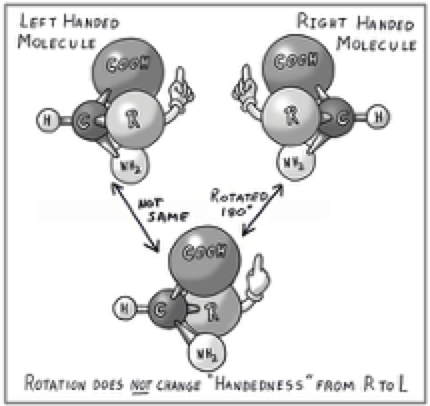
    Most biologically active organic compounds are asymmetrical in three-dimensional space. Because of their asymmetry, they could possibly exist as two hypothetical forms that are ”nonsuperimposable” mirror images of each other. Like your hands (and feet) they may be what chemists have classified as right-handed molecules, or they may be left-handed. Look at the accompanying illustration below. (Like the others, it was created by our son, Jim Martin Jr. He even added the clever metaphor of a gloved hand just to help you keep track.) Each amino acid has one key carbon atom to which are attached an amino group (-NH2), an acid group (-COOH), a hydrogen atom (-H), and an -R group. This generic R represents any one of 20 different attachments. There are hundreds of known amino acids, but only 20 that get built into proteins, and -R differentiates each of these 20, depending upon the molecular structure of -R. In the smallest amino acid, glycine, R is a second hydrogen atom, which causes it to have a plane of symmetry between the two H atoms.

    If you can imagine rotating the upper right molecule (labeled “right handed”) 1800 about its vertical axis, it becomes the sketch at the bottom. The gloved hand initially had its palm toward us, but because of this rotation, has gone around to where it has its palm pointing away from us. Nothing has changed. The geometry of the lower drawing is still identical to the upper right version, and both are “nonsuperimposable” mirror images of the one at upper left. (Remember, the amino acid does not really have a gloved hand ─ this is just a figment of artistic license to help keep track.)
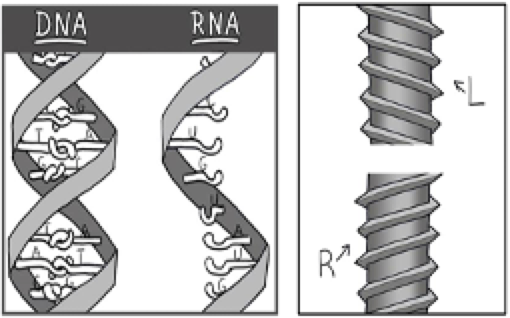
    In the laboratory, when we synthesize an amino acid from symmetrical reagents, the product is always a 50:50 mixture of right-handed and left-handed forms. In living cells, however, only the left-handed amino acids get selected in each and every turn. Does that not seem to imply some geometrical preference? In the laboratory, when we synthesize any sugar, we always get a 50:50 mixture of its two mirror image forms. Yet, when sugars are biosynthesized in plants, no left-handed sugars are formed, only right-handed sugars.

    This has to be a consequence of the 3-D geometry of the sugar-forming proteins in the cell having been assembled exclusively from left-handed amino acids. One more piece of this puzzle: DNA and RNA are also asymmetrical. Watson and Crick made their model of DNA using right-handed deoxy-ribose in its helical backbone, and found that this could only form a stable double helix that was right-handed.

    Compare the last statement with what we see in every hardware store when we need to buy wood screws or nuts and bolts. Since early in the Industrial Revolution, stores agreed never to have left-handed screws, nuts, and bolts in the building, only “righty-tighty” threads. If both kinds were present, imagine the confusion as left-handed types got mixed with right-handed. You rarely encounter any mechanical parts with left-handed threads. When you do, there is a special reason for it. The bolt for the rotor blade of a gas-powered lawn mower is left-handed to ensure that the cutting action tightens the bolt, and does not loosen it. Even stranger, the coupling for attaching a propane gas tank to its hose is always left-handed ─ probably to save you from connecting a garden hose if the original hose is lost!

    For our purposes, we have just covered one of the most difficult, yet fascinating, lessons from organic chemistry.

    • As if the enormous code of DNA, with almost infinite odds against its correct life-defining code ever dialing up by chance, weren’t remotely improbable enough, and
    • As if the three-way “chicken-egg” conundrum surrounding DNA, RNA, proteins and sugars weren’t too complex to have resulted from random reactions,
    • We now see that there is this miraculous three-dimensional requirement that DNA and RNA have right-handed helices ─ so that proteins are biosynthesized exclusively from left-handed amino acids, and now, after all that,
    • Only right-handed ribose can properly align RNA in a right-handed helix, to ensure that only left-handed amino acids get selected.

    I cannot tell you what you must believe about these relationships. If I tried, you would properly reject the attempt. Only you can make your own decisions about what you fundamentally believe. You may already have a religious faith, or you may be working your way through doubt, based perhaps on science. What I ask you to think about, based on my subject field of organic chemistry, is this. With arguments based on the comparative anatomies that led Darwin to his evolution theory, powerful objections could be raised against any belief in a theistic God, by whatever name the ancients perceived our Creator. Now that we have this molecular evidence about the architectural structure and reactivity of DNA and RNA, and their mutual interdependence with sugars and proteins, we have practically absolute proof of the mechanism for Darwin’s descent with modification. That is good for a belief in evolution, but not so much for atheism. It seems the deeper we go into the incredible complexity of this molecular basis for evolution, the more difficult it becomes to use it as an argument for atheistic belief in a purposeless origin of life.

    It is your choice. What you believe is entirely up to you. You are free to conclude that there is no God, and choose instead to believe that complex life is the product of awesome chance. Or you may choose to belief that there is a First Cause for life. We cannot look to science to prove the existence, the power, or the nature of God. Science has no means to approach this question experimentally. But what science can do is reveal to us that life is indeed miraculous in being based upon the elaborate relationships of thousands of chemical substances, so infinitely complex that life is unlikely to have arisen and evolved by unguided chance.

    #   #   #

    James G. Martin, Ph.D., was an associate professor of chemistry at his alma mater, Davidson College, from 1960 to 1972. While serving at Davidson, in 1966, he was elected to the Mecklenburg County Board of Commissioners. He served for six years, chairing the body four 4 1/2 years. He was a president of the North Carolina Association of County Commissioners. He then served in the U.S. House of Representatives 1973-1985 and was governor of North Carolina 1985-1993. In 1993 he retired from political life and became chairman of the board of the James Cannon Research Center of Carolinas Medical Center in Charlotte, NC. He is the author of Revelation Through Science, and provided this article and illustraionts as excerpts from that book.

    #   #   #

    See related article on the reality of order as evidence of God on this page.

    Top image of DNA by Gerd Altmann from Pixabay

  • What Did Jesus Really Look Like?

    What Did Jesus Really Look Like?

    By Joan Taylor*
    Originally published on BBC.com (Edited by Real God staff)

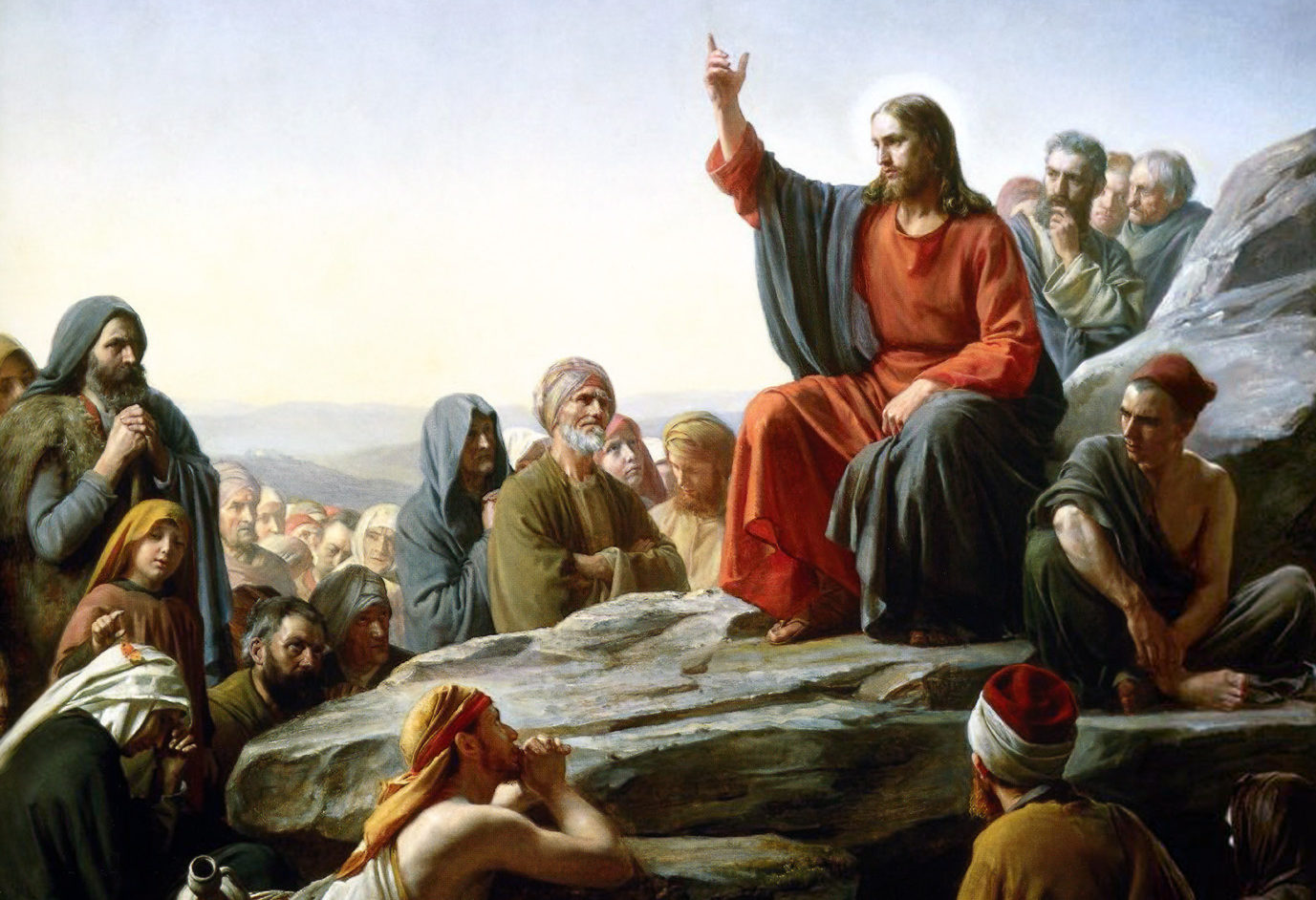
    Everyone thinks they know what Jesus looks like. He is the most painted figure in all of Western art, recognized everywhere as having long hair and a beard, a long robe with long sleeves (often white) and a mantle (often blue).

    Jesus is so familiar that he can be recognized on pancakes or pieces of toast.

    But did he really look like this? Probably not.

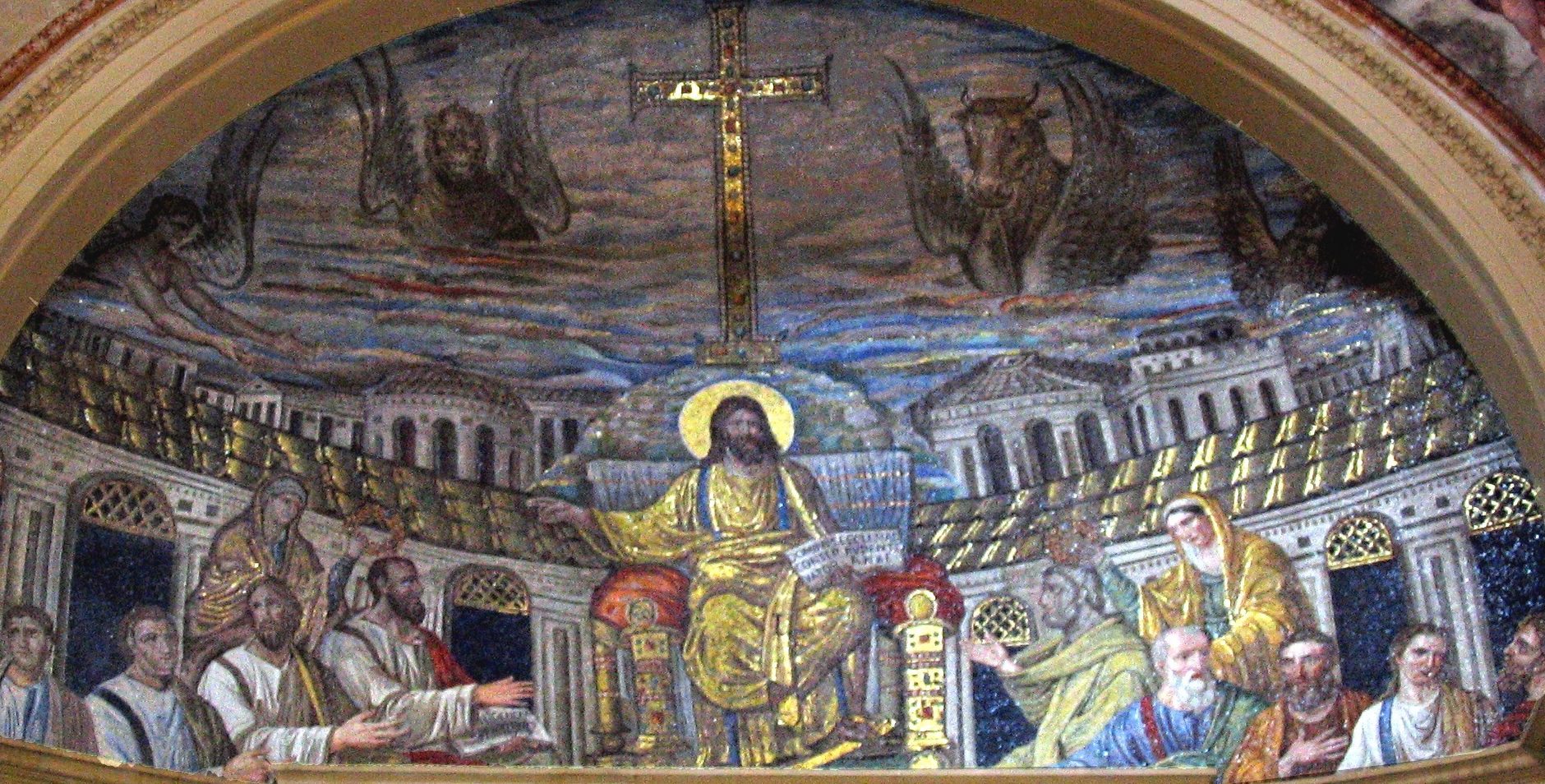
    In fact this familiar image of Jesus actually comes from the Byzantine era, from the 4th Century onwards, and Byzantine representations of Jesus were symbolic – they were all about meaning, not historical accuracy. They were based on the image of an enthroned emperor, as we see in the altar mosaic of the Santa Pudenziana church in Rome (shown above).**

    The halo also comes from classical art – it was originally a feature of the sun god (Apollo, or Sol Invictus) but was added to Jesus’s head to show his heavenly nature. Jesus is dressed in a gold toga. He is the heavenly ruler of all the world, familiar from the famous statue of long-haired and bearded Olympian Zeus on a throne – a statue so well-known that the Roman Emperor Augustus had a copy of himself made in the same style (without the godly long hair and beard).

    Byzantine artists, looking to show Christ’s heavenly rule as cosmic King, invented him as a younger version of Zeus. What has happened over time is that this visualisation of heavenly Christ – today sometimes remade along hippie lines – has become our standard model of the early Jesus.

    So what did Jesus really look like? Let’s go from head to toe.

    1. Hair and beard

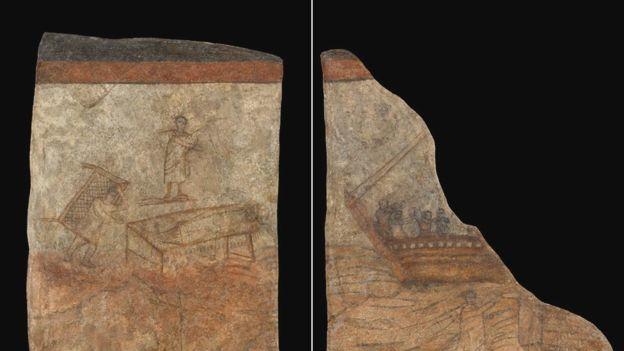
    When early Christians were not showing Christ as heavenly ruler, they showed Jesus as an actual man like any other: beardless and short-haired. The earliest surviving paintings of Jesus, from the church at the ruined city of Dura-Europos on the Euphrates (dating from first half of the 3rd Century AD), looks like this:


    But perhaps, as a kind of wandering sage, Jesus would have had a beard, for the simple reason that he did not go to barbers. General scruffiness and a beard were thought to differentiate a philosopher (who was thinking of higher things) from everyone else. The Stoic philosopher Epictetus considered it “appropriate according to Nature”.

    Otherwise, in the 1st Century Graeco-Roman world, being clean-shaven and short-haired was considered absolutely essential. A great mane of luxuriant hair and a beard was a godly feature, not replicated in male fashion. Even a philosopher kept his hair fairly short.

    A beard was not distinctive of being a Jew in antiquity. In fact, one of the problems for oppressors of Jews at different times was identifying them when they looked like everyone else (a point made in the book of Maccabees). However, images of Jewish men on Judaea Capta coins, issued by Rome after the capture of Jerusalem in 70AD, indicate captive men who are bearded. So Jesus, as a philosopher with the “natural” look, might well have had a short beard, but his hair was probably not very long.

    If he had had even slightly long hair, we would expect some reaction. Jewish men who had unkempt beards and were slightly long-haired were immediately identifiable as men who had taken a Nazirite vow. This meant they would dedicate themselves to God for a period of time, not drink wine or cut their hair – and at the end of this period they would shave their heads in a special ceremony in the temple in Jerusalem (as described in Acts chapter 21, verse 24).

    But Jesus did not keep a Nazirite vow, because he is often found drinking wine – his critics accuse him of drinking far, far too much of it (Matthew chapter 11, verse 19). If he had had long hair, and looked like a Nazirite, we would expect some comment on the discrepancy between how he appeared and what he was doing – the problem would be that he was drinking wine at all.

    2. Clothing

    At the time of Jesus, wealthy men donned long robes for special occasions, to show off their high status in public. In one of Jesus’s teachings, he says, “Beware of the scribes, who desire to walk in long robes (stolai), and to have salutations in the marketplaces, and have the most important seats in the synagogues and the places of honour at banquets” (Mark chapter 12, verses 38-39).

    The sayings of Jesus are generally considered the more accurate parts of the Gospels, so from this we can assume that Jesus really did not wear such robes.

    Overall a man in Jesus’s world would wear a knee-length tunic, a chiton, and a woman an ankle-length one, and if you swapped these around it was a statement. Thus, in the 2nd Century Acts of Paul and Thecla, when Thecla, a woman, dons a short (male) tunic it is a bit of a shock. These tunics would often have coloured bands running from the shoulder to the hem and could be woven as one piece.
    On top of the tunic you would wear a mantle, a himation, and we know that Jesus wore one of these because this is what a woman touched when she wanted to be healed by him (see, for example, Mark chapter 5, verse 27). A mantle was a large piece of woollen material, though it was not very thick and for warmth you would want to wear two.

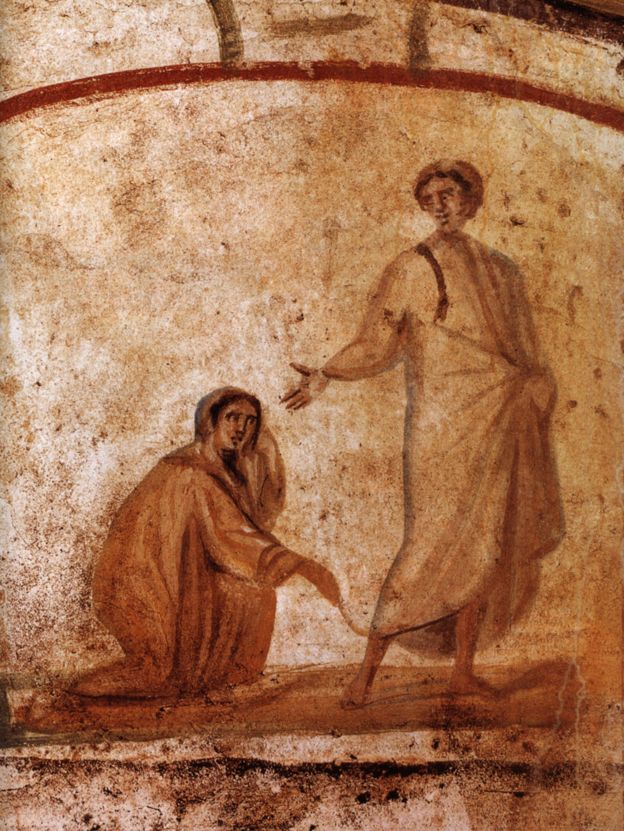
    A himation, which could be worn in various ways, like a wrap, would hang down past the knees and could completely cover the short tunic. (Certain ascetic philosophers even wore a large himation without the tunic, leaving their upper right torso bare, but that is another story.) The image at right depicts Jesus and a woman touching his mantle (Image courtesy of WIKI COMMONS).

    Power and prestige were indicated by the quality, size and colour of these mantles. Purple and certain types of blue indicated grandeur and esteem. These were royal colours because the dyes used to make them were very rare and expensive.

    But colours could also indicate something else. The historian Josephus describes the Zealots (a Jewish group who wanted to push the Romans out of Judaea) as a bunch of murderous transvestites who donned “dyed mantles” – chlanidia – indicating that they were women’s wear. This suggests that real men, unless they were of the highest status, should wear undyed clothing.

    Jesus did not wear white, however. This was distinctive, requiring bleaching or chalking, and in Judaea it was associated with a group called the Essenes – who followed a strict interpretation of Jewish law. The difference between Jesus’s clothing and bright, white clothing, is described in Mark chapter 9, when three apostles accompany Jesus to a mountain to pray and he begins to radiate light. Mark recounts that Jesus’s himatia (in the plural the word may mean “clothing” or “clothes” rather than specifically “mantles”) began “glistening, intensely white, as no fuller on earth could bleach them”. Before his transfiguration, therefore, Jesus is presented by Mark as an ordinary man, wearing ordinary clothes, in this case undyed wool.

    We are told more about Jesus’s clothing during his execution, when the Roman soldiers divide his himatia (in this case the word probably refers to two mantles) into four shares (see John chapter 19, verse 23). One of these was probably a tallith, or Jewish prayer shawl. This mantle with tassels (tzitzith) is specifically referred to by Jesus in Matthew chapter 23, verse 5. This was a lightweight himation, traditionally made of undyed creamy-coloured woollen material, and it probably had some kind of an indigo stripe or threading.

    3. Feet

    On his feet, Jesus would have worn sandals. Everyone wore sandals. In the desert caves close to the Dead Sea and Masada, sandals from the time of Jesus have come to light, so we can see exactly what they were like. They were very simple, with the soles made of thick pieces of leather sewn together, and the upper parts made of straps of leather going through the toes.

    4. Features

    And what about Jesus’s facial features? They were Jewish. That Jesus was a Jew (or Judaean) is certain in that it is found repeated in diverse literature, including in the letters of Paul. And, as the Letter to the Hebrews states: “It is clear that our Lord was descended from Judah.” So how do we imagine a Jew at this time, a man “about 30 years of age when he began,” according to Luke chapter 3?

    In 2001 forensic anthropologist Richard Neave created a model of a Galilean man for a BBC documentary, Son of God, working on the basis of an actual skull found in the region (image at right). He did not claim it was Jesus’s face. It was simply meant to prompt people to consider Jesus as being a man of his time and place, since we are never told he looked distinctive.

    Whatever some artists may imagine, Jesus is unlikely to have had blue eyes. He would have had brown eyes and black hair, and olive-brown skin like other Jews of the Middle East.

    For all that may be done with modelling on ancient bones, I think the closest correspondence to what Jesus really looked like is found in the depiction of Moses on the walls of the 3rd Century synagogue of Dura-Europos, since it shows how a Jewish sage was imagined in the Graeco-Roman world. Moses is imagined in undyed clothing, and in fact his one mantle is a tallith, since in the Dura image of Moses parting the Red Sea one can see tassels (tzitzith) at the corners. At any rate, this image is far more correct as a basis for imagining the historical Jesus than the adaptations of the Byzantine Jesus that have become standard: he’s short-haired and with a slight beard, and he’s wearing a short tunic, with short sleeves, and a himation.

    Moses appears to be wearing a tunic with blue bands, as well as a tallith (as a mantle) with blue decoration – in both cases the blue would probably have been created by dying with indigo. Here is the image most likely representative of what Jesus really looked like:

    Jesus looks like

    #  #  #

    Joan Taylor is the author of “What Did Jesus Look Like?”, available on amazon.com. In 1995 she won an Irene Levi-Sala Award in Israel’s archaeology, for the book version of her PhD thesis, Christians and the Holy Places (Oxford: Clarendon, 1993, rev. 2003). In 1996-7 she was Visiting Lecturer and Research Associate in Women’s Studies in New Testament at Harvard Divinity School, a position she held in association with a Fulbright Award. She has also been Honorary Research Fellow in the Departments of History and Jewish Studies at University College London. She has taught at King’s College London since 2009.

    **Photo by Sixtus, digitally enhanced, from Wikipedia

  • God Is Real – Arguments for the Existence of God

    arguments for the existence of God

    Arguments for the existence of God go back hundreds of years, and even 2,000 years ago the ancient Greeks debated the subject and offered “proofs”. Practically speaking, it is not possible to “prove” that God is real without first accepting, implicitly or explicitly, that a Supreme Being or God is even a possibility. Some have said that the fact that so many people have an instinctive notion or awareness of God is evidence itself that God is real.

    In philosophy and logic, there are two kinds of proof: those based on experience, also called empirical, inductive or a posteriori arguments; and those based on logic, also called deductive or a priori arguments. Logical arguments are based on the acceptance of initial facts or statements, from which one may logically deduce certain conclusions. A third category, called subjective arguments, focuses on mankind’s subjective experience of God in history and in personal experience. “Arguments” are similar to “proofs” of the existence of God; they are efforts to argue that God is real, and if they are convincing, can be considered “proofs.”

    Most agree, however, that the reality of God cannot be proved by either experience or logic, but rather it is up to each individual to accept the reality of God by a “leap of faith.” The Apostle Paul wrote in Hebrews 11, “Now faith is the substance of things hoped for, the evidence of things not seen.” Basically faith is belief in the reality of the invisible, although many believe that the visible world, the beauties of creation etc., are powerful evidence of a designer, creator God.

    Much of the following content is based in part on this Wikipedia page. For a drill-down on the “miracle of DNA” and how it could not have evolved by accident, read this article on our site.

    Empirical arguments for the existence of God

    Argument from beauty

    One form of the argument from beauty is that the elegance of the laws of physics, which have been empirically discovered, or the elegant laws of mathematics, which are abstract but which have empirically proven to be useful, is evidence of a creator deity who has arranged these things to be beautiful and not ugly. But even more relevant for most people is the beauty of the natural world – magnificent sunsets, gorgeous flowers, the ocean, waterfalls, birds, other animals, the face of a loved one, and so much more. The world is more beautiful than it has to be because God made it so.

    Argument from consciousness

    The argument from consciousness claims that human consciousness cannot be explained by the physical mechanisms of the human body and brain, therefore, asserting that there must be non-physical aspects to human consciousness. This is held as indirect evidence of God, given that notions about souls and the afterlife in Christianity and Islam would be consistent with such a claim.

    The notion of the soul was created before modern understanding of neural networks and the physiology of the brain. Decades of experimentation led cognitive science to consider thought and emotion as physical processes, although the experience of consciousness still remains poorly understood. The hard problem of consciousness remains as to whether different people subjectively experience the world in the same way — for example, that the color blue looks the same inside the minds of different people, though this is a philosophical problem with both physical and non-physical explanations, and is ultimately unanswerable.

    Argument from design

    The teleological argument, or the argument from design, asserts that certain features of the universe and of living things must be the product of an intelligent cause.[38] Its proponents are mainly Christians.[39] 

    Another version of this is the argument based on order, the orderliness of the universe, which could not be accidental. This is explained in this article on this website.

    Rational warrant

    Philosopher Stephen Toulmin is notable for his work in the history of ideas[40] that features the (rational) warrant: a statement that connects the premises to a conclusion.

    Joseph Hinman applied Toulmin’s approach in his argument for the existence of God, particularly in Hinman’s book The Trace of God: A Rational Warrant for Belief.[41] Instead of attempting to prove the existence of God, Hinman argues you can “demonstrate the rationally-warranted nature of belief”.[42]

    Hinman uses a wide range of studies, including ones by Robert Wuthnow, Andrew Greeley, Mathes and Kathleen Nobel to establish that mystical experiences are life-transformative in a way that is significant, positive and lasting.[43] He draws on additional work to add several additional major points to his argument. First, the people who have these experiences not only do not exhibit traditional signs of mental illness but often are in better mental and physical health than the general population due to the experience.[44] Second, the experiences work. In other words, they provide a framework for navigating life that is useful and effective.[45] All of the evidence of the positive effects of the experience upon people’s lives he, adapting a term from Derrida, terms “the trace of God”: the footprints left behind that point to the impact.

    Finally, he discusses how both religious experience and belief in God is, and has always been, normative among humans:[46] people do not need to prove the existence of God. If there is no need to prove, Hinman argues, and the Trace of God (for instance, the impact of mystical experiences on them), belief in God is rationally warranted.

    Inductive arguments

    Some have put forward arguments for the existence of God based on inductive reasoning. For example, one class of philosophers asserts that the proofs for the existence of God present a fairly high probability, though not absolute certainty. A number of obscure points, they say, always remain; an act of faith is required to dismiss these difficulties. This view is maintained, among others, by the Scottish statesman Arthur Balfour in his book The Foundations of Belief (1895). The opinions set forth in this work were adopted in France by Ferdinand Brunetière, the editor of the Revue des deux Mondes. Many orthodox Protestants express themselves in the same manner, as, for instance, Dr. E. Dennert, President of the Kepler Society, in his work Ist Gott tot?[47]

    Logical arguments for the existence of God

    Aquinas’ Five Ways (Arguments) 

    In article 3, question 2, first part of his Summa Theologica, Thomas Aquinas developed his five arguments for God’s existence. These arguments are grounded in an Aristotelian ontology and make use of the infinite regression argument.[48][49] Aquinas did not intend to fully prove the existence of God as he is orthodoxly conceived (with all of his traditional attributes), but proposed his Five Ways as a first stage, which he built upon later in his work.[50] Aquinas’ Five Ways argued from the unmoved mover, first cause, necessary being, argument from degree, and the argument from final cause.

    • The unmoved mover argument asserts that, from our experience of motion in the universe (motion being the transition from potentiality to actuality) we can see that there must have been an initial mover. Aquinas argued that whatever is in motion must be put in motion by another thing, so there must be an unmoved mover.[48]
    • Aquinas’ argument from first cause started with the premise that it is impossible for a being to cause itself (because it would have to exist before it caused itself) and that it is impossible for there to be an infinite chain of causes, which would result in infinite regress. Therefore, there must be a first cause, itself uncaused.[48]
    • The argument from necessary being asserts that all beings are contingent, meaning that it is possible for them not to exist. Aquinas argued that if everything can possibly not exist, there must have been a time when nothing existed; as things exist now, there must exist a being with necessary existence, regarded as God.[48]
    • He also argued from degree, considering the occurrence of degrees of goodness. He believed that things which are called good, must be called good in relation to a standard of good—a maximum. There must be a maximum goodness that which causes all goodness.[48]
    • The argument from final cause asserts the view that non-intelligent objects are ordered towards a purpose. Aquinas argued that these objects cannot be ordered unless they are done so by an intelligent being, which means that there must be an intelligent being to move objects to their ends: God.[48]

    Cosmological argument

    The cosmological argument, or “first cause” argument asserts that since everything that begins to exist has a cause, and since the universe began to exist, the universe must have had a cause which was itself not caused. This ultimate first cause is identified with God. Christian apologist William Lane Craig gives a version of this argument in the following form:[51]

    1. Whatever begins to exist has a cause.
    2. The Universe began to exist.
    3. Therefore, the Universe had a cause.

    Ontological argument

    The ontological argument has been formulated by philosophers including St. Anselm and René Descartes. The argument proposes that God’s existence is self-evident. The logic, depending on the formulation, reads roughly as follows:[52]

    Whatever is contained in a clear and distinct idea of a thing must be predicated of that thing; but a clear and distinct idea of an absolutely perfect Being contains the idea of actual existence; therefore since we have the idea of an absolutely perfect Being such a Being must really exist.[52]

    Thomas Aquinas criticized the argument for proposing a definition of God which, if God is transcendent, should be impossible for humans to understand.[53] Immanuel Kant criticized the proof from a logical standpoint: he stated that the term “God” really signifies two different terms: both idea of God, and the reality of God. Kant concluded that the proof is equivocation, based on the ambiguity of the word God.[54] Kant also challenged the argument’s assumption that existence is a predicate (of perfection) because it does not add anything to the essence of a being. If existence is not a predicate, then it is not necessarily true that the greatest possible being exists.[55] A common rebuttal to Kant’s critique is that, although “existence” does add something to both the concept and the reality of God, the concept would be vastly different if its referent is an unreal Being. Another response to Kant is attributed to Alvin Plantinga, who says that even if one were to grant that existence is not a real predicate, necessary existence, which is the correct formulation of an understanding of God, is a real predicate.

    Subjective arguments for the existence of God

    Arguments from historical events or personages

    Arguments from testimony

    Arguments from testimony rely on the testimony or experience of witnesses, possibly embodying the propositions of a specific revealed religion. Richard Swinburne argues that it is a principle of rationality that one should accept testimony unless there are strong reasons for not doing so.[63]

    • The witness argument gives credibility to personal witnesses, contemporary and throughout the ages. A variation of this is the argument from miracles (also referred to as “the priest stories”) which relies on testimony of supernatural events to establish the existence of God.
    • The majority argument argues that the theism of people throughout most of recorded history and in many different places provides prima facie demonstration of God’s existence.
    Arguments grounded in personal experiences
    • The Argument from a proper basis argues that belief in God is “properly basic”; that it is similar to statements like “I see a chair” or “I feel pain”. Such beliefs are non-falsifiable and, thus, neither provable nor disprovable; they concern perceptual beliefs or indisputable mental states.
    • In Germany, the School of Friedrich Heinrich Jacobi taught that human reason is able to perceive the suprasensible. Jacobi distinguished three faculties: sense, reason, and understanding. Just as sense has immediate perception of the material so has reason immediate perception of the immaterial, while the understanding brings these perceptions to a person’s consciousness and unites them to one another.[64] God’s existence, then, cannot be proven (Jacobi, like Immanuel Kant, rejected the absolute value of the principle of causality), it must be felt by the mind.
    • The same theory was advocated in Germany by Friedrich Schleiermacher, who assumed an inner religious sense by means of which people feel religious truths. According to Schleiermacher, religion consists solely in this inner perception, and dogmatic doctrines are inessential.[65]

    #  #  #

    Top photo by Davide Cantelli on Unsplash