Category: Science-God

  • Faith and the Miracle of DNA – Revelation of God through Science

    Faith and the Miracle of DNA – Revelation of God through Science


    By James G. Martin, author of
    Revelation through Science

    Is DNA and its relationship to RNA and other organic molecules a miracle? This article explores a compelling example from organic chemistry based on the three-dimensional structures of certain sugars, proteins, and DNA and RNA; and how each of these depends on all the others. Could any of these exist without the others? Could this happen by unguided chance, even in 4.5 billion years?

    Four hundred years ago, the theological academies and hierarchies were rocked by Galileo’s findings that Venus orbited the Sun, the Moon’s visage was pock-marked, and Jupiter had four moons. Peaceful accommodation slowly settled in, only to be wracked again 250 years later by Darwin’s evolutionary explanation of “The Origin of Species.” When atheists seized upon Darwin’s theory as a rejection of God, fundamentalist Christians countered by rejecting evolution. Following the famous 1925 Scopes “Monkey Trial” in Dayton, Tennessee, US Courts have steadily blocked any requirement to teach religious tenets against science in public schools.

    These and related historic episodes are recounted in Revelation through Science, along with various dodges, such as the curious planetary concept of Tycho Brahe that the Sun and Moon orbit around the stationary Earth, while all other planets revolve around the Sun. Many theologians and scientists attempted to resolve matters with a duality principle: that science and religion are non-overlapping domains with separate but equal access to truth.

    Scientists Point to Creation by Powers that Transcend Nature

    In recent decades, however, a group of theistic astronomers, physicists, paleontologists and physicians have raised a fascinating theme that many fundamental concepts of science point to creation by powers that transcend and predate nature. Among these are the “Big Bang” origin of the universe, with highly precise values for the physical constants for (a) gravity, (b) the strong nuclear force, (c) the weak nuclear force, and (d) the electromagnetic force. Together, these comprise a coordinated set of fine-tuned, “anthropic coincidences” leading to the conclusion that life is either highly conditional upon a foreordained purpose ─ or it is extremely lucky. This modern reconciliation between science and religion flourished with the publication of The Language of God, by N.I.H. Director Francis Collins, MD, former head of the “Human Genome Project.” Its title is an obvious and intentional metaphor for the built-in growth and control of our bodies and lives by the enormous yet explicit code within our DNA. This supports both a mechanistic proof of evolution and a belief that evolution had to be purposeful.
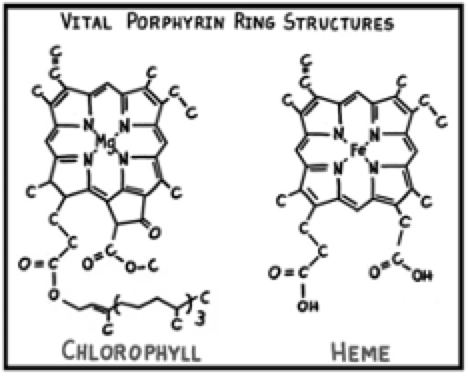
    Believing that similar “evidence for belief” abounds in other fields of science, I have a series of chapters about astronomy, physics, geology, biology, chemistry and biochemistry, each with its own anthropic coincidences. The earlier sections are to some extent reflections of similar accounts from previous authors, but Revelation Through Science is the first with provocative examples from my field of organic chemistry, and they are numerous and compelling.  There are a number of extremely complex naturally occurring compounds like hemoglobin that defy laboratory synthesis, or chlorophyll, which has been synthesized in five years by Nobel laureate Robert Woodward and his large team of Harvard chemists. Of course, ordinary leaves can do this any sunny day, not only routinely, but far more proficiently, albeit by incredibly sophisticated processes.

    Could DNA, RNA and other Complex Molecules Evolve only by Chance?

    My most compelling example from organic chemistry is based on the three-dimensional structures of certain sugars, proteins, and DNA and RNA; and how each of these depends on all the others. Could any of these exist without the others? Could this happen by unguided chance, even in 4.5 billion years? What you think about this enigma and choose to believe is up to you. But consider this.

    All natural proteins consist of long polymeric chains of the same set of 20 amino acids. Much has been made of the fact that many amino acids have been found in meteorites, and can even be formed by lightning discharges in an atmosphere that probably existed when Earth was sterile ─ before the first living organisms 3.5 billion years ago. It was typically implied that these amino acids could somehow self-assemble into complex proteins. These would coalesce into clusters, which would evolve into living cells. Knowing today how proteins are biosynthesized in cells, we can see that it is far more complicated than that. First of all, let me introduce you to a phenomenal relationship, between two small but essential sugars, the proteins that catalyze their biosynthesis, and the peculiar structures of DNA and RNA. We can then unfold and examine an extraordinary structural co-dependence between them, just as unfamiliar to most readers as it is miraculous in its improbability ─ leaving us to wonder how nature ever got it precisely correct. Think of it as the most profound three-way “chicken and egg” conundrum: which came first?

    The simple sugar known as ribose is a vital part of the helical backbone of ribonucleic acid (RNA). Its cousin deoxy-ribose is a vital part of the backbone of the double helix of deoxy-ribonucleic acid (DNA). Both of these simple sugars are biosynthesized in cells by certain proteins. To complete this puzzle, all proteins are biosynthesized in cells. For each of some 23,000 distinct human proteins, the defining sequence of amino acids is predetermined by the genetic code carried by its unique RNA. The RNA that is specific for one protein gets its code directly from one of 23,000 genes in the vast catalog of codes built into DNA.

    Among the structural components of every molecule of RNA and DNA is the particular sugar, ribose or deoxy-ribose respectively. Human DNA has thousands of genes, 23,000 of which carry the codes for each of 23,000 vital proteins, Each gene code is transcribed to a particular RNA molecule. It translates this code into the sequential selection of 20 different amino acids (by the hundreds) for its particular protein. Among these proteins are some that facilitate replication of DNA code prior to cell division, so that each new cell has the same code. Other proteins guide the biosynthesis of ribose and deoxy-ribose. Without these two sugars, there could be no DNA or RNA. Without RNA having the code from protein-coding genes of DNA, there could be no functioning proteins. Without carbohydrate-synthesizing proteins, there could be no sugars. They are mutually and existentially interrelated.

    Each Life-Giving Compound is Wholly Interdependent with Each and All the Others

    You see, each of these life-giving compounds is wholly interdependent with each and all of the others. Which came first? It seems to me that all had to be present in the very first living cell, or it could never reproduce its replica living cell.
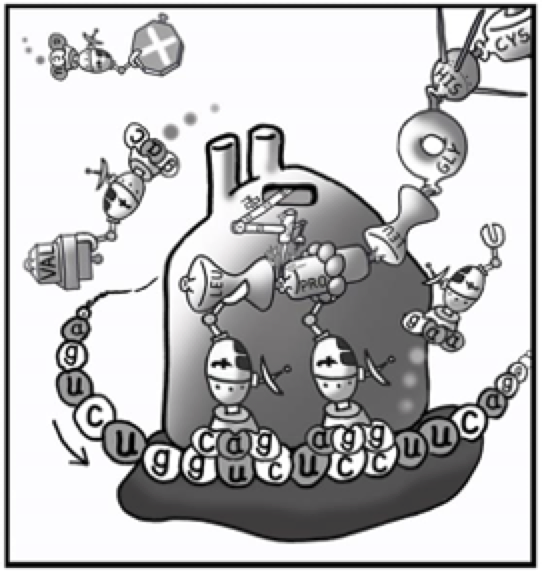
    This next cartoon tries to simplify the mental image of this, without getting lost in the elaborate actual molecular structures of the  various compounds. The protein factory, called a ribosome, is represented by a blob of a giant protein with suggestions of smoke stacks to help you accept that however complex it is, it is basically a kind of factory. Little machines called transfer-RNA are running around inside the cell with a short code that allows each t-RNA to select one specific amino acid. Finally, there is a chain of codes representing messenger-RNA, riding across the bottom of the ribosome, with the entire chemical code for this one protein. Each three-part sequence of its code can only match one specific t-RNA, thus keeping absolute control of the intended sequence of amino acids being connected by the ribosome as it constructs the new protein.

    You will notice that I slipped in the adjective, “intended,” because I believe this process is far beyond anything that could just happen by trial-and-error collisions of lifeless molecules. In all the annals of evolutionary biology, none of this works if there is no DNA with its thousands of specifically coded genes. Nothing like it works if there is no biosynthesis of not only these two sugars, but also the thousands of diverse, biologically active proteins. You are free to reach your own conclusion and belief as to whether life with this kind of complexity could ever occur by unguided chance, or was intended.

    Nature has a Mysterious Preference for Left-Handed Molecules

    Would you allow me to introduce an even more amazing “miracle,” if I may call it that? Again, you will be free to see if it fits your personal belief system when I finish. You may want to rest your mind a bit before proceeding. Take a moment for a few deep breaths. Relax your jaw. Massage your forehead. When you are ready, consider this.

    Most biologically active organic compounds are asymmetrical in three-dimensional space. Because of their asymmetry, they could possibly exist as two hypothetical forms that are ”nonsuperimposable” mirror images of each other. Like your hands (and feet) they may be what chemists have classified as right-handed molecules, or they may be left-handed. Look at the accompanying illustration below. (Like the others, it was created by our son, Jim Martin Jr. He even added the clever metaphor of a gloved hand just to help you keep track.) Each amino acid has one key carbon atom to which are attached an amino group (-NH2), an acid group (-COOH), a hydrogen atom (-H), and an -R group. This generic R represents any one of 20 different attachments. There are hundreds of known amino acids, but only 20 that get built into proteins, and -R differentiates each of these 20, depending upon the molecular structure of -R. In the smallest amino acid, glycine, R is a second hydrogen atom, which causes it to have a plane of symmetry between the two H atoms.
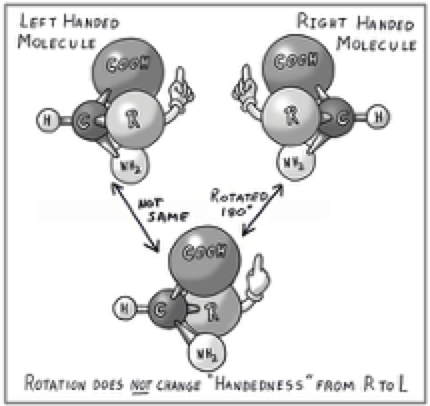
    If you can imagine rotating the upper right molecule (labeled “right handed”) 1800 about its vertical axis, it becomes the sketch at the bottom. The gloved hand initially had its palm toward us, but because of this rotation, has gone around to where it has its palm pointing away from us. Nothing has changed. The geometry of the lower drawing is still identical to the upper right version, and both are “nonsuperimposable” mirror images of the one at upper left. (Remember, the amino acid does not really have a gloved hand ─ this is just a figment of artistic license to help keep track.)

    In the laboratory, when we synthesize an amino acid from symmetrical reagents, the product is always a 50:50 mixture of right-handed and left-handed forms. In living cells, however, only the left-handed amino acids get selected in each and every turn. Does that not seem to imply some geometrical preference? In the laboratory, when we synthesize any sugar, we always get a 50:50 mixture of its two mirror image forms. Yet, when sugars are biosynthesized in plants, no left-handed sugars are formed, only right-handed sugars.
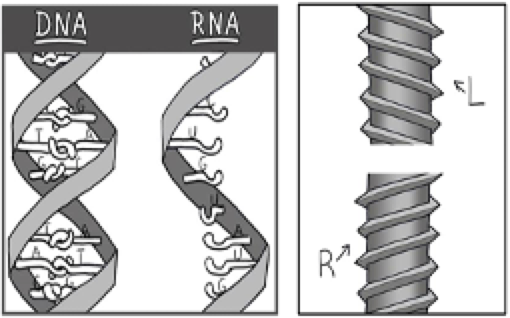
    This has to be a consequence of the 3-D geometry of the sugar-forming proteins in the cell having been assembled exclusively from left-handed amino acids. One more piece of this puzzle: DNA and RNA are also asymmetrical. Watson and Crick made their model of DNA using right-handed deoxy-ribose in its helical backbone, and found that this could only form a stable double helix that was right-handed.

    Compare the last statement with what we see in every hardware store when we need to buy wood screws or nuts and bolts. Since early in the Industrial Revolution, stores agreed never to have left-handed screws, nuts, and bolts in the building, only “righty-tighty” threads. If both kinds were present, imagine the confusion as left-handed types got mixed with right-handed. You rarely encounter any mechanical parts with left-handed threads. When you do, there is a special reason for it. The bolt for the rotor blade of a gas-powered lawn mower is left-handed to ensure that the cutting action tightens the bolt, and does not loosen it. Even stranger, the coupling for attaching a propane gas tank to its hose is always left-handed ─ probably to save you from connecting a garden hose if the original hose is lost!

    For our purposes, we have just covered one of the most difficult, yet fascinating, lessons from organic chemistry.
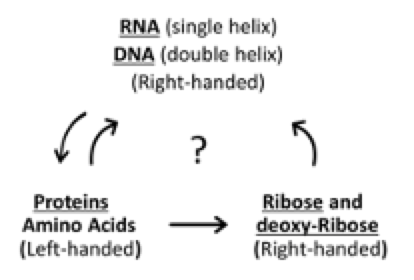
    • As if the enormous code of DNA, with almost infinite odds against its correct life-defining code ever dialing up by chance, weren’t remotely improbable enough, and
    • As if the three-way “chicken-egg” conundrum surrounding DNA, RNA, proteins and sugars weren’t too complex to have resulted from random reactions,
    • We now see that there is this miraculous three-dimensional requirement that DNA and RNA have right-handed helices ─ so that proteins are biosynthesized exclusively from left-handed amino acids, and now, after all that,
    • Only right-handed ribose can properly align RNA in a right-handed helix, to ensure that only left-handed amino acids get selected.

    I cannot tell you what you must believe about these relationships. If I tried, you would properly reject the attempt. Only you can make your own decisions about what you fundamentally believe. You may already have a religious faith, or you may be working your way through doubt, based perhaps on science. What I ask you to think about, based on my subject field of organic chemistry, is this. With arguments based on the comparative anatomies that led Darwin to his evolution theory, powerful objections could be raised against any belief in a theistic God, by whatever name the ancients perceived our Creator. Now that we have this molecular evidence about the architectural structure and reactivity of DNA and RNA, and their mutual interdependence with sugars and proteins, we have practically absolute proof of the mechanism for Darwin’s descent with modification. That is good for a belief in evolution, but not so much for atheism. It seems the deeper we go into the incredible complexity of this molecular basis for evolution, the more difficult it becomes to use it as an argument for atheistic belief in a purposeless origin of life.

    It is your choice. What you believe is entirely up to you. You are free to conclude that there is no God, and choose instead to believe that complex life is the product of awesome chance. Or you may choose to belief that there is a First Cause for life. We cannot look to science to prove the existence, the power, or the nature of God. Science has no means to approach this question experimentally. But what science can do is reveal to us that life is indeed miraculous in being based upon the elaborate relationships of thousands of chemical substances, so infinitely complex that life is unlikely to have arisen and evolved by unguided chance.

    #   #   #

    James G. Martin, Ph.D., was an associate professor of chemistry at his alma mater, Davidson College, from 1960 to 1972. While serving at Davidson, in 1966, he was elected to the Mecklenburg County Board of Commissioners. He served for six years, chairing the body four 4 1/2 years. He was a president of the North Carolina Association of County Commissioners. He then served in the U.S. House of Representatives 1973-1985 and was governor of North Carolina 1985-1993. In 1993 he retired from political life and became chairman of the board of the James Cannon Research Center of Carolinas Medical Center in Charlotte, NC. He is the author of Revelation Through Science, and provided this article and illustraionts as excerpts from that book.

    #   #   #

    See related article on the reality of order as evidence of God on this page.

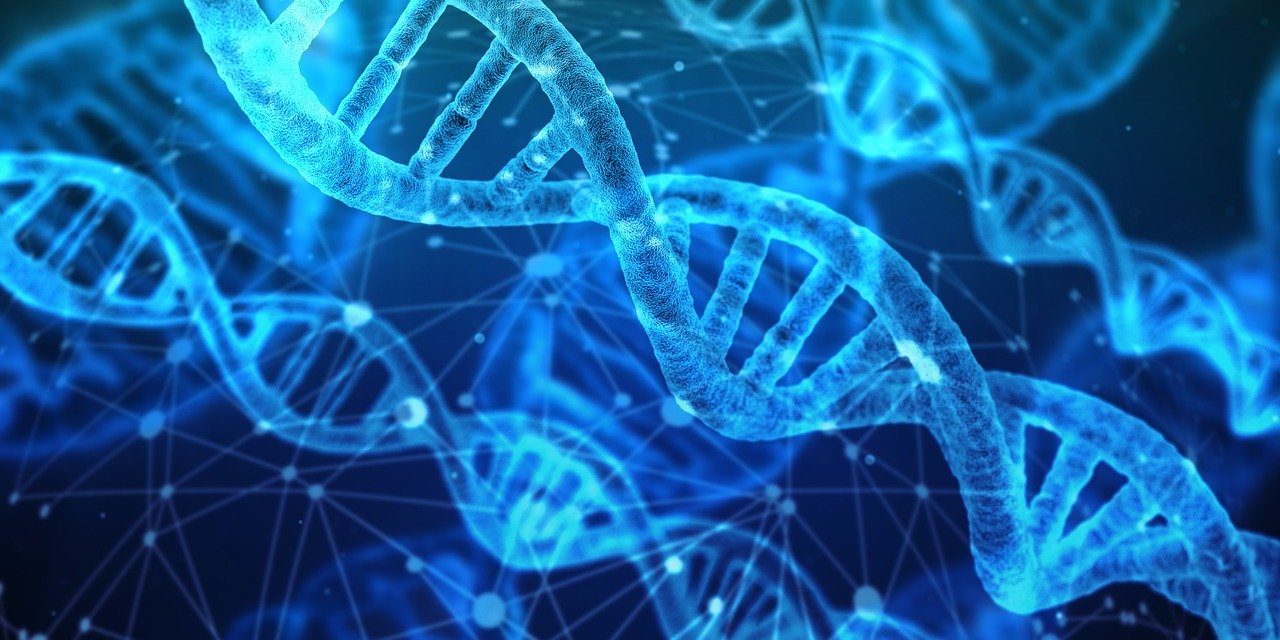
    Top image of DNA by Gerd Altmann from Pixabay

  • Arguments Why God (Very Probably) Exists

    Arguments Why God (Very Probably) Exists

    By Robert H. Nelson, University of Maryland.*

    The question of whether a god exists is heating up in the 21st century. According to a Pew survey, the percent of Americans having no religious affiliation reached 23 percent in 2014. Among such “nones,” 33 percent said that they do not believe in God – an 11 percent increase since only 2007.

    Such trends have ironically been taking place even as, I would argue, the probability for the existence of a supernatural god have been rising. In my 2015 book, “God? Very Probably: Five Rational Ways to Think about the Question of a God,” I look at physics, the philosophy of human consciousness, evolutionary biology, mathematics, the history of religion and theology to explore whether such a god exists. I should say that I am trained originally as an economist, but have been working at the intersection of economics, environmentalism and theology since the 1990s.

    Laws of math

    In 1960 the Princeton physicist – and subsequent Nobel Prize winner – Eugene Wigner raised a fundamental question: Why did the natural world always – so far as we know – obey laws of mathematics?

    As argued by scholars such as Philip Davis and Reuben Hersh, mathematics exists independent of physical reality. It is the job of mathematicians to discover the realities of this separate world of mathematical laws and concepts. Physicists then put the mathematics to use according to the rules of prediction and confirmed observation of the scientific method.

    But modern mathematics generally is formulated before any natural observations are made, and many mathematical laws today have no known existing physical analogues.

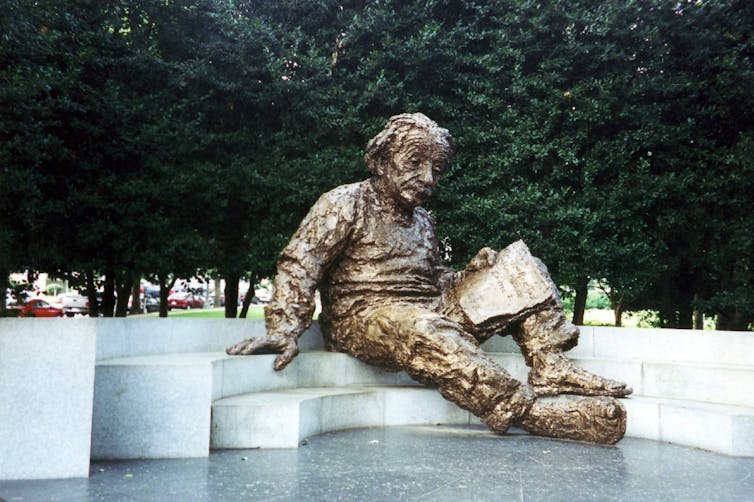
    Einstein Memorial, National Academy of Sciences, Washington, D.C.
    Wally Gobetz, CC BY-ND

    Einstein’s 1915 general theory of relativity, for example, was based on theoretical mathematics developed 50 years earlier by the great German mathematician Bernhard Riemann that did not have any known practical applications at the time of its intellectual creation.

    In some cases the physicist also discovers the mathematics. Isaac Newton was considered among the greatest mathematicians as well as physicists of the 17th century. Other physicists sought his help in finding a mathematics that would predict the workings of the solar system. He found it in the mathematical law of gravity, based in part on his discovery of calculus.

    At the time, however, many people initially resisted Newton’s conclusions because they seemed to be “occult.” How could two distant objects in the solar system be drawn toward one another, acting according to a precise mathematical law? Indeed, Newton made strenuous efforts over his lifetime to find a natural explanation, but in the end he could say only that it is the will of God.

    Despite the many other enormous advances of modern physics, little has changed in this regard. As Wigner wrote, “the enormous usefulness of mathematics in the natural sciences is something bordering on the mysterious and there is no rational explanation for it.”

    In other words, as I argue in my book, it takes the existence of some kind of a god to make the mathematical underpinnings of the universe comprehensible.

    Math and other worlds

    In 2004 the great British physicist Roger Penrose put forward a vision of a universe composed of three independently existing worlds – mathematics, the material world and human consciousness. As Penrose acknowledged, it was a complete puzzle to him how the three interacted with one another outside the ability of any scientific or other conventionally rational model.

    How can physical atoms and molecules, for example, create something that exists in a separate domain that has no physical existence: human consciousness?

    It is a mystery that lies beyond science.

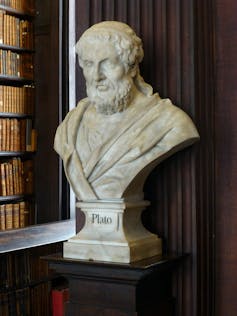
    Plato. image by Elizabethe, CC BY-NC-ND

    This mystery is the same one that existed in the Greek worldview of Plato, who believed that abstract ideas (above all mathematical) first existed outside any physical reality. The material world that we experience as part of our human existence is an imperfect reflection of these prior formal ideals. As the scholar of ancient Greek philosophy, Ian Mueller, writes in “Mathematics And The Divine,” the realm of such ideals is that of God.

    Indeed, in 2014 the MIT physicist Max Tegmark argues in “Our Mathematical Universe” that mathematics is the fundamental world reality that drives the universe. As I would say, mathematics is operating in a god-like fashion.

    The mystery of human consciousness

    The workings of human consciousness are similarly miraculous. Like the laws of mathematics, consciousness has no physical presence in the world; the images and thoughts in our consciousness have no measurable dimensions.

    Yet, our nonphysical thoughts somehow mysteriously guide the actions of our physical human bodies. This is no more scientifically explicable than the mysterious ability of nonphysical mathematical constructions to determine the workings of a separate physical world.

    Until recently, the scientifically unfathomable quality of human consciousness inhibited the very scholarly discussion of the subject. Since the 1970s, however, it has become a leading area of inquiry among philosophers.

    Recognizing that he could not reconcile his own scientific materialism with the existence of a nonphysical world of human consciousness, a leading atheist, Daniel Dennett, in 1991 took the radical step of denying that consciousness even exists.

    Finding this altogether implausible, as most people do, another leading philosopher, Thomas Nagel, wrote in 2012 that, given the scientifically inexplicable – the “intractable” – character of human consciousness, “we will have to leave [scientific] materialism behind” as a complete basis for understanding the world of human existence.

    As an atheist, Nagel does not offer religious belief as an alternative, but I would argue that the supernatural character of the workings of human consciousness adds grounds for raising the probability of the existence of a supernatural god.

    Evolution and faith

    Evolution is a contentious subject in American public life. According to Pew, 98 percent of scientists connected to the American Association for the Advancement of Science “believe humans evolved over time” while only a minority of Americans “fully accept evolution through natural selection.”

    As I say in my book, I should emphasize that I am not questioning the reality of natural biological evolution. What is interesting to me, however, are the fierce arguments that have taken place between professional evolutionary biologists. A number of developments in evolutionary theory have challenged traditional Darwinist – and later neo-Darwinist – views that emphasize random genetic mutations and gradual evolutionary selection by the process of survival of the fittest.

    From the 1970s onwards, the Harvard evolutionary biologist Stephen Jay Gould created controversy by positing a different view, “punctuated equilibrium,” to the slow and gradual evolution of species as theorized by Darwin.

    In 2011, the University of Chicago evolutionary biologist James Shapiro argued that, remarkably enough, many micro-evolutionary processes worked as though guided by a purposeful “sentience” of the evolving plant and animal organisms themselves. “The capacity of living organisms to alter their own heredity is undeniable,” he wrote. “Our current ideas about evolution have to incorporate this basic fact of life.”

    A number of scientists, such as Francis Collins, director of the U.S. National Institutes of Health, “see no conflict between believing in God and accepting the contemporary theory of evolution,” as the American Association for the Advancement of Science points out.

    For my part, the most recent developments in evolutionary biology have increased the probability of a god.

    Miraculous ideas at the same time?

    For the past 10,000 years at a minimum, the most important changes in human existence have been driven by cultural developments occurring in the realm of human ideas.

    In the Axial Age (commonly dated from 800 to 200 B.C.), world-transforming ideas such as Buddhism, Confucianism, the philosophies of Plato and Aristotle, and the Hebrew Old Testament almost miraculously appeared at about the same time in India, China, ancient Greece and among the Jews in the Middle East, groups having little interaction with one another.

    Many world-transforming ideas, such as Buddhism, appeared in the world around the same time. Karyn Christner, CC BY

    The development of the scientific method in the 17th century in Europe and its modern further advances have had at least as great a set of world-transforming consequences. There have been many historical theories, but none capable, I would argue, of explaining as fundamentally transformational a set of events as the rise of the modern world. It was a revolution in human thought, operating outside any explanations grounded in scientific materialism, that drove the process.

    That all these astonishing things happened within the conscious workings of human minds, functioning outside physical reality, offers further rational evidence, in my view, for the conclusion that human beings may well be made “in the image of [a] God.”

    Different forms of worship

    In his commencement address to Kenyon College in 2005, the American novelist and essayist David Foster Wallace said that: “Everybody worships. The only choice we get is what to worship.”

    Even though Karl Marx, for example, condemned the illusion of religion, his followers, ironically, worshiped Marxism. The American philosopher Alasdair MacIntyre thus wrote that for much of the 20th century, Marxism was the “historical successor of Christianity,” claiming to show the faithful the one correct path to a new heaven on Earth.

    In several of my books, I have explored how Marxism and other such “economic religions” were characteristic of much of the modern age. So Christianity, I would argue, did not disappear as much as it reappeared in many such disguised forms of “secular religion.”

    That the Christian essence, as arose out of Judaism, showed such great staying power amidst the extraordinary political, economic, intellectual and other radical changes of the modern age is another reason I offer for thinking that the existence of a god is very probable.The Conversation

    #  #  #

    Robert H. Nelson, was a professor at the University of Maryland. He is now deceased.

    Note from Editor of The Conversation US: This is a revised version of the original piece. We have done so to make explicit the author’s expertise with regard to the subject of this article. We have also incorporated important context that was missing in the original version. Republished under a Creative Commons license.

    Top image by Michael Peligro, CC BY-ND

  • Can Science Prove The Existence Of God?

    Can Science Prove The Existence Of God?

    By Ethan Siegel*
    There’s an argument that many people make: that the natural world, and humanity’s existence in the Universe, point towards a divine creator that brought forth all of this into existence. To the best of our knowledge, Earth exists with a plethora of conditions that allowed for our existence, and does so in a way that no other world can match.

    The Earth at night from the International Space Station. Image credit: ISS expedition 25 / NASA.

    We live in a particularly privileged place. We live on a planet that has all the right ingredients for life, including:

      • We’re at the right distance from our Sun so that temperatures are conducive to life.
      • We have the right atmospheric pressure for liquid water at our surface.
      • We have the right ingredients — the right balance of heavy elements and organic molecules — for life to arise.
      • We have the right amount of water so that our world has both oceans and continents.
      • And life started on our world very early, sustained itself for our planet’s entire history, and gave rise to us: sentient, self-aware creatures.

    If you look at the other worlds we know of, the difference is striking.

    The terrain of, for example, Mars, is woefully inhospitable to life as we recognize it. Image credit: Mars Spirit Rover, NASA/JPL/Cornell.

    The claim that’s often made isn’t merely that Earth is unlikely; it’s that our planet, with the confluence of circumstances that gave rise to us, is statistically impossible, even given all the stars and galaxies in the Universe. The emergence of intelligent life is so outlandishly unexpected, given all the factors that needed to occur in just the right particular order, that our Universe must have been designed specifically to give rise to us. Otherwise, the argument goes, the odds of us coming to be would be so infinitesimally small that it’s unreasonable to believe it could have happened by chance.

    This is a very compelling argument for many people, but it’s important to ask ourselves three questions to make sure we’re approaching this honestly. We’ll go through them one at a time, but here are the three, so we know what we’re getting into.

    1. What are, scientifically, the conditions that we need for life to arise?
    2. How rare or common are these conditions elsewhere in the Universe?
    3. And finally, if we don’t find life in the places and under the conditions where we expect it, can that prove the existence of God?

    These are all big questions, so let’s give them the care they deserve.

    Deep under the sea, around hydrothermal vents, where no sunlight reaches, life still thrives on Earth. Image credit: NOAA/PMEL Vents Program, via http://www.pmel.noaa.gov/eoi/.

    1.) What are, scientifically, the conditions that we need for life to arise?

    In other words, things did occur in a very specific way here on Earth, but how many of them does life-as-we-know-it require, versus how many of them happened in a particular way here, but could have easily happened under different conditions elsewhere?

    The things I listed earlier are based on the assumption that any life that’s out there is going to be like us in the sense that it will be based on the chemistry of atoms and molecules, occur with liquid water as a basic requirement of its functioning, and won’t be in an environment that we know to be toxic to all terrestrial life. For those criteria alone, we already know there are billions of planets in our galaxy alone that fit the bill.

    Kepler 186f is one of a great many candidates for a very Earth-like planet. Image credit: NASA/Ames/JPL-Caltech.

    Our studies of exoplanets — of worlds around stars beyond our own — have shown us that there’s a huge variety of rocky planets orbiting at the right distance from their central stars to have liquid water on their surfaces if they have anything akin to atmospheres like our own. We are starting to approach the technological capabilities of detecting exo-atmospheres and their compositions around worlds as small as our own; currently, we can get down to about Neptune-sized worlds, although the James Webb Space Telescope will advance that further in under a decade.

    But aren’t there other things we need to worry about? What if we were too close to the galactic center; wouldn’t the high rate of supernovae fry us, and sterilize life? What if we didn’t have a planet like Jupiter to clear out the asteroid belt; wouldn’t the sheer number of asteroids flying our way wipe any life that manages to form out? And what about the fact that we’re here now, when the Universe is relatively young? Many stars will live for trillions of years, but we’ve only got about another billion or two before our Sun gets hot enough to boil our oceans. When the Universe was too young, there weren’t enough heavy elements. Did we come along at just the right time, to not only make it in our Universe, but to witness all the galaxies before dark energy pushes them away?

    A primarily ultraviolet view of the galactic center reveals a complex, intricate view of stars that visible light won't allow us to see. Image credit: Midcourse Space Experiment (MSX) composite, via http://coolcosmos.ipac.caltech.edu/image_galleries/MSX/galactic_center.html.

    Probably not, to all of these questions! If we were closer to the galactic center, yes: the star formation rate is higher and the rate of supernovae is higher. But the main thing that means is that large numbers of heavy elements are created faster there, giving complex life an opportunity starting from earlier times. Here in the outskirts, we have to wait longer! And as for sterilizing a planet, you’d have to be very close to a supernova for that to happen — far closer than stars typically are to one another near the galactic center — or else in the direct path of a hypernova beam. But even in this latter case, which would still be incredibly rare, you’re likely to only sterilize half your world at once, because these beams are short-lived!

    Even a focus, ultra-energetic, nearby supernova might not be enough to extinguish life on a thoroughly inhabited planet. Image credit: NASA / JPL.

    Their atmospheres wouldn’t be blown off entirely, deep-ocean life should still survive, and there’s every reason to believe that no matter how bad it got, the conditions would be ripe for complex life to make a comeback. Once life takes hold on a world, or gets “under its skin” as some biologists say, it’s very hard to annihilate it entirely. And this simply won’t do.

    Multiple scenarios for the asteroid belt may each have advantages for life evolving on the inner worlds. Perhaps none of them are prohibitive to the evolution of intelligent life. Image credit: NASA/ESA/A. Feild, STScI.

    Same deal for asteroids. Yes, a solar system without a Jupiter-like planet would have many more asteroids, but without a Jupiter-like planet, would their orbits ever get perturbed to fling them into the inner solar system? Would it make extinction events more common, or rarer? Moreover, even if there were increased impacts, would that even make complex/intelligent life less likely, or would the larger number of extinction events accelerate the differentiation of life, making intelligence more likely? The evidence that we need a Jupiter for life is specious at best, just like the evidence that we need to be at this location in our galaxy is also sparse. But even if those things were true, we’d still have huge numbers of worlds — literally tens-to-hundreds of millions — that met those criteria in our galaxy alone.

    And finally, we did come along relatively early, but the ingredients for stars and solar systems like our own were present in large abundances in galaxies many billions of years before our own star system formed. We’re even finding potentially habitable worlds where life may be 7-to-9-billion-years-old! So no, we’re probably not first. The conditions that we need for life to arise, to the best we can measure, seem to exist all over the galaxy, and hence probably all over the Universe as well.

    Potentially habitable worlds may be possible around a large variety of stars. Image credit: © Lisa Kaltenegger (MPIA).

    2.) How rare or common are these conditions elsewhere in the Universe?

    Scientists didn’t help themselves with overly optimistic estimates of the Drake equation: the equation that is most commonly used to estimate the number of intelligent civilizations in our galaxy. Of all the science presented in Carl Sagan’s original Cosmos series, his estimates of the Drake equation represented possibly the worst science in the series. So let’s run through the actual numbers to the best that science knows — complete with realistic uncertainties — and see what we come up with.

    As best as we can tell — extrapolating what we’ve discovered to what we haven’t yet looked at or been able to see — there ought to be around 1-to-10 trillion planets in our galaxy that orbit stars, and somewhere around 40-to-80 billion of them are candidates for having all three of the following properties:

    • being rocky planets,
    • located where they’ll consistently have Earth-like temperatures,
    • and that ought to support and sustain liquid water on their surfaces!

    So the worlds are there, around stars, in the right places! In addition to that, we need them to have the right ingredients to bring about complex life. What about those building blocks; how likely are they to be there?

    Organic molecules are found in star forming regions, stellar remnants and interstellar gas, all throughout the Milky Way. Image credit: NASA / ESA and R. Humphreys (University of Minnesota).

    Believe it or not, these heavy elements — assembled into complex molecules — are unavoidable by this point in the Universe. Enough stars have lived and died that all the elements of the periodic table exist in fairly high abundances all throughout the galaxy. But are they assembled correctly? Taking a look towards the heart of our own galaxy is molecular cloud Sagittarius B, shown at the top of this page. In addition to water, sugars, benzene rings and other organic molecules that just “exist” in interstellar space, we find surprisingly complex ones.

    Organic molecules found throughout the Universe, particularly towards the galactic center. Image credit: Oliver Baum, University of Cologne.

    Like ethyl formate (left) and n-propyl cyanide (right), the former of which is responsible for the smell of raspberries! Molecules just as complex as these are literally in every molecular cloud, protoplanetary disk and stellar outflow that we’ve measured. So with tens of billions of chances in our galaxy alone, and the building blocks already in place, you might think — as Fermi did — that the odds of intelligent life arising many times in our own galaxy is inevitable.

    But first, we need to make life from non-life. This is no small feat, and is one of the greatest puzzles around for natural scientists in all disciplines: the problem of abiogenesis. At some point, this happened for us, whether it happened in space, in the oceans, or in the atmosphere, it happened, as evidenced by our very planet, and its distinctive diversity of life. But thus far, we’ve been unable to create life from non-life in the lab. So it’s not yet possible to say how likely it is, although we’ve taken some amazing steps in recent decades. It could be something that happens on as many as 10–25% of the possible worlds, which means up to 20 billion planets in our galaxy could have life on them. (Including — past or present — others in our own Solar System, like Mars, Europa, Titan or Enceladus.) That’s our optimistic estimate.

    A young planet with the potential conditions for life could grow into an Earth-like world, or could remain devoid of life forever. Image credit: NASA / JPL-Caltech.

    But it could be far fewer than that as well. Was life on Earth likely? In other words, if we performed the chemistry experiment of forming our Solar System over and over again, would it take hundreds, thousands or even millions of chances to get life out once? Conservatively, let’s say it’s only one-in-a-million, which still means, given the pessimistic end of 40 billion planets with the right temperature, there are still at least 40,000 planets out there in our galaxy alone with life on them.

    But we want something even more than that; we’re looking for large, specialized, multicellular, tool-using creatures. So while, by many measures, there are plenty of intelligent animals, we are interested in a very particular type of intelligence. Specifically, a type of intelligence that can communicate with us, despite the vast distances between the stars! So how common is that? From the first, self-replicating organic molecule to something as specialized and differentiated as a human being, we know we need billions of years of (roughly) constant temperatures, the right evolutionary steps, and a whole lot of luck. What are the odds that such a thing would have happened? One-in-a-hundred? Well, optimistically, maybe. That might be how many of these planets stay at constant temperatures, avoid 100% extinction catastrophes, evolve multicellularity, gender, become differentiated and encephalized enough to eventually learn to use tools.

    Once intelligence, tool use and curiosity combine in a single species, perhaps interstellar ambitions become inevitable. Image credit: Original source Dennis Davidson for http://www.nss.org/, retrieved from Brian Shiro at Astronaut For Hire.

    But it could be far fewer; we are not an inevitable consequence of evolution so much as a happy accident of it. Even one-in-a-million seems like it might be too optimistic for the odds of human-like animals evolving on an Earth-like world with the right ingredients for life; I could easily imagine that it would take a billion Earths (or more) to get something like human beings out just once.

    If we take the optimistic estimate of the optimistic estimate above, perhaps 200 million worlds are out there capable of communicating with us, in our galaxy alone. But if we take the pessimistic estimate about both life arising and the odds of it achieving intelligence, there’s only a one-in-25,000 chance that our galaxy would have even one such civilization. In other words, life is a fantastic bet, but intelligent life may not be. And that’s according to reasonable scientific estimates, but it assumes we’re being honest about our uncertainties here, too. So the conditions for life are definitely everywhere, but life itself could be common or rare, and what we consider intelligent life could be common, rare or practically non-existent in our galaxy. As science finds out more, we’ll learn more about that.

    And finally…

    Reaching, broadcasting and listening for the evidence of others has so far returned an empty, lonely result. Image credit: Victor Bobbett.

    3.) If we don’t find life in the places and under the conditions where we expect it, can that prove the existence of God? Certainly, there are people that will argue that it does. But to me, that’s a terrible way to place your faith. Consider this:

    Do you want or need your belief in a divine or supernatural origin to the Universe to be based in something that could be scientifically disproven?

    I am very open about not being a man of faith myself, but of having tremendous respect for those who are believers. The wonderful thing about science is that it is for everybody who’s willing to look to the Universe itself to find out more information about it. Why would your belief in God require that science give a specific answer to this question that we don’t yet know the answer to? Will your faith be shaken if we find that, hey, guess what, chemistry works to form life on other worlds the same way it worked in the past on this one? Will you feel like you’ve achieved some sort of spiritual victory if we scour the galaxy and find that human beings are the most intelligent species on all the worlds of the Milky Way?

    The Milky Way as seen at La Silla Observatory. Image credit: ESO / Håkon Dahle.

    Or, can your beliefs — whatever they are — stand up to whatever scientific truths the Universe reveals about itself, regardless of what they are? In the professional opinion of practically all scientists who study the Universe, it is very likely that there is life on other worlds, and that there’s a very good chance — if we invest in looking for it — that we’ll be able to find the first biological signatures on other worlds within a single generation. Whether there’s intelligent life beyond Earth, or more specifically, intelligent life beyond Earth in our galaxy that’s still alive right now, is a more dubious proposition, but the outcome of this scientific question in no way favors or disfavors the existence of God, any more than the order of whether fish or birds evolved first on Earth favors or disfavors a deity’s existence.

    There may or may not be other worlds very, very similar to our own out there, but neither result is necessarily an indicator of a divine presence. Image credit: Wikimedia Commons / Lucianomendez.

    The truths of the Universe are written out there, on the Universe itself, and are accessible to us all through the process of inquiry. To allow an uncertain faith to stand in as an answer where scientific knowledge is required does us all a disservice; the illusion of knowledge — or reaching a conclusion before obtaining the evidence — is a poor substitute for what we might actually come to learn, if only we ask the right questions. Science can never prove or disprove the existence of God, but if we use our beliefs as an excuse to draw conclusions that scientifically, we’re not ready for, we run the grave risk of depriving ourselves of what we might have come to truly learn.

    So as Obama’s presidency draws to a close and a Trump presidency begins, I implore you: don’t let your faith, whatever it may be, close you off to the joys and wonders of the natural world. The joys of knowing — of figuring out the answers to questions for ourselves — is one that none of us should be cheated out of. May your faith, if you have one, only serve to enhance and enrich you, not take the wonder of science away!

    *Reprinted from Forbes magazine by permission of the author. Follow Ethan Siegel  on Twitter. Check out his website or some of his other work here.
    He is  a Ph.D. astrophysicist, author, and science communicator, who professes physics and astronomy at various colleges. He has won numerous awards for science writing since 2008 for his blog, Starts With A Bang, including the award for best science blog by the Institute of Physics. His two books, Treknology: The Science of Star Trek from Tricorders to Warp Drive, Beyond the Galaxy: How humanity looked beyond our Milky Way and discovered the entire Universe, are available for purchase at Amazon.