Category: God-Jesus

  • Christmas And Light In The Darkness – Makes Sense, Doesn’t It?

    Christmas And Light In The Darkness – Makes Sense, Doesn’t It?

    By Dr. Craven Williams, Contributor

    See Romans 8:31-35; 37-39

    The Winter Solstice was December 21, 4 days before Christmas. It was the longest night of the year. Beginning on that day each day lengthens by 2 minutes, 7 seconds each day.  As Jupiter and Saturn align we are reminded of Psalm19 where the poet declares,”The heavens are telling the glory of God and the firmament proclaims his handiwork.” And as a result, the “Bethlehem Star” appeared again for the first time since March 4, 1226.

    1. Makes sense doesn’t it:  the shortest day of the year means the longest night of the year.  
    2. Makes sense doesn’t it: the happiest of days underscores the despair of the saddest time.
    3. Makes sense doesn’t it: the most depressing feelings arise from a time when we need to appear jolly and joyful.  

    This is the time during Advent, we remember those who grieve a loss of a loved one, a relationship, a job, a goal. In the midst of the happy lights of Advent and Christmas glooms the dreary, dark memories of sad losses, simple loneliness, social isolation. The Pandemic has added substantially to that sense of loss as now there are gaping holes in the hearts of 300,000 Americans caused by Covid-19.

    Many Bible passages employ the imagery of light and dark. 

    • John depicts God being born as a child to the “light shining in the darkness” (John 1:5). 
    • “God is light, and in him is no darkness at all” (1 John 1:5). 
    • “Those who walked in darkness have seen a great light” (Isaiah 9:2). 
    • “The Lord is my light and my salvation” (Psalm 27:1). 
    • “Even the darkness is not dark to You; darkness is as light with You” (Psalm 139:12).
    •  In heaven, “night shall be no more; they need no lamp or sun, for the Lord God will be their light” (Revelation 22:5).

    St. Francis’s daily prayer was “Enlighten the darkness of my heart.” We know darkness, despite our many electrical and battery-powered lights. 

    1. John Milton spoke of “darkness visible,” which we often call “depression.” 
    2. There is something fitting in the notion that God came when it was the darkest. God’s love embraces and warms us. 
    3. We love the carol, “In the bleak Midwinter.” That was when God made his humble home with us.

     Fascinating: God created us and put us in this world, but God holds out for us the promise of another world. Fra Giovanni, the medieval poet, wrote, “The gloom of the world is but a shadow. Behind it, yet within reach, is joy. There is radiance and glory in the darkness, could we but see. And to see, we have only to look. I beseech you to look!”


    It seems that our longest nights and saddest feelings occur in the presence of others who all seem so happy with their jingle bells jingling and their heralds harking.

    • Little wonder we are so attracted to Little Orphan Annie and Harry Potter.   We see in these plucky characters our worst fears realized and so root for them because we are hopeful that we’d face it with the same measures of grit and grace as they did.
    • Little wonder our souls cry out in sad anxiety as we think of thousands of immigrant children being separated from their parents and families at the Southern border.  
    • Little wonder that we come together whenever we have an opportunity to light a candle and remember people and events each candle reflects.  

    Romans touches on this same deep need and, indeed, primal fear.  Paul is describing our life in the Spirit — life, that is, when we are joined to Christ and others via our baptism and belief. He has already announced that there is no condemnation for those in Christ and proclaimed that we are not only God’s children but also God’s heirs and Christ’s co-heirs. 

    As if it couldn’t get any better, Paul continues, stressing that because God is for us, no one can stand against us. No one can level charges that deprive us of God’s inheritance or diminish our status among God’s beloved. His language is stirring: “Who will bring any charge against God’s elect? It is God who justifies. Who is to condemn? It is Christ Jesus, who died, yes, who was raised, who is at the right hand of God, who indeed intercedes for us” (8:33-34).

    Did you hear that? Jesus — 

    1. The one who preached God’s kingdom and embodied God’s love, 
    2. The one who suffered and died on the cross and was raised again — 
    3. This Jesus is now interceding for us regardless of our loss or the source of our sadness.

    The Apostle Paul continues, “Who will separate us from the love of Christ? Will hardship, or distress, or persecution, or famine, or nakedness, or peril, or sword?” (v35). His answer, of course, is a resounding, “No, in all these things we are more than conquerors through him who loved us.” 

    And then comes the best part, “For I am convinced that neither death, nor life, nor angels, nor rulers, nor things present, nor things to come, nor powers, nor height, nor depth, nor anything else in all creation, will be able to separate us from the love of God in Christ Jesus our Lord” (v.38-39).

    And there it is — The Apostle Paul addressing our deepest needs and deepest fears, all in one fell swoop. We will not — we cannot! — be separated from God:

    But now, let us add in our own list of things that might separate us from God. What are those things that we have done or have happened to us that we fear separate us from God? And then, having had the courage to name our deepest fears, to hear Paul’s response: “Nothing will be able to separate us from God!”

    That’s right. God loves us…forever…no matter what. That’s why Jesus came: to invite us, to embrace us, to empower us with God’s love. Thanks be to God: for this Word and promise!  Makes sense doesn’t it!

    Romans 8:31-35; 37-39

    “31 What then are we to say about these things? If God is for us, who is against us? 32He who did not withhold his own Son, but gave him up for all of us, will he not with him also give us everything else? 33Who will bring any charge against God’s elect? It is God who justifies. 34Who is to condemn? It is Christ Jesus, who died, yes, who was raised, who is at the right hand of God, who indeed intercedes for us. 35Who will separate us from the love of Christ? Will hardship, or distress, or persecution, or famine, or nakedness, or peril, or sword?

    37No, in all these things we are more than conquerors through him who loved us. 38For I am convinced that neither death, nor life, nor angels, nor rulers, nor things present, nor things to come, nor powers, 39nor height, nor depth, nor anything else in all creation, will be able to separate us from the love of God in Christ Jesus our Lord.”


    Image by OpenClipart-Vectors from Pixabay

     

  • Have Faith in God – The Bible and Life Show Us How

    Have Faith in God – The Bible and Life Show Us How

    “Have faith in God,” said Jesus in Mark 11:22-25. “Truly I tell you, if anyone says to this mountain, ‘Go, throw yourself into the sea,’ and does not doubt in their heart but believes that what they say will happen, it will be done for them. Therefore I tell you, whatever you ask for in prayer, believe that you have received it, and it will be yours.”

    Because of this verse and others, many people have come to believe that “have faith in God” means “you can have anything if you ask for it in prayer and believe you have received it.” But this does not always happen in many people’s lives.

    When I was a young boy, I wanted a red toolbox more than anything. Every night before I went to sleep, I prayed to God that I would wake up in the morning and a red toolbox would be at the foot of my bed. I honestly believed I had received it – until I looked closely. No red toolbox. (Note: As soon as I  got a paying job after college, I bought my own red toolbox, which I still have and cherish today.)

    “God is not a genie,” as Pastor Rick Warren is fond of saying. And having faith in God is not as simple ask making a wish and believing it will come true. As Warren also says in the same article, “God knows what’s best, and you don’t,” and “Sometimes Christians pray in conflict,” such as people on both sides of a football game praying for victory.

    Have Faith in God – to be God

    So what this means is “have faith in God – to be God,” not to do anything you ask. God knows what’s best, and you don’t. And someone else may be praying for a different outcome as you pray for your own.

    Another common misunderstanding about Jesus “move mountains” verses above is that Jesus often spoke in hyperbole, or vivid exaggeration, to make an unforgettable point to his listeners. It is unlikely that anyone has ever moved a literal mountain with prayer. But as some commentators have noted, if you view a mountain as a huge obstacle, faith in God can indeed help you move it or change it.

    It’s important to understand what the word “faith” means, both in the Bible and in our lives. The English word closest in meaning to faith is trust. As my wife and I have learned over the years, the phrase, “Don’t you trust me?” can be deceiving. It is unwise to trust any human being absolutely because we all make mistakes and miss the mark (the real meaning of the word sin). Rather we learn to “trust to.” I trust you to tell the truth. I trust you to be there when you say you will. I trust you to do what is best for our family. I trust you not to run up a lot of credit card debt.

    In like manner, it is wise to trust God to do certain things consistent with his nature and the Biblical message, but not everything, such as magically delivering red toolboxes or ponies to young boys.

    “Have Faith In God” Can Have Many Meanings

    Paul’s famous statement about having faith in God is this: “Now faith is the substance of things hoped for, the evidence of things not seen.” (Hebrews 11:1). But he goes on to say, “This is what the ancients were commended for. By faith we understand that the universe was formed at God’s command, so that what is seen was not made out of what was visible.”

    Wow! This profound definition of faith has nothing to do with red toolboxes or moving mountains, but more to do with the creation of the universe! Not only was no one around to see it (except God), but the visible universe was not even made out of visible parts, but out of nothing in what is now called the “Big Bang.” Do you have faith that God created the universe?

    The Stanford Encyclopedia of Philosophy* explains several different models or concepts of faith (edited for this article):

    “’Faith’ is a broad term, expressing a range of different concepts. It is most often used in theistic religious faith—faith in God—and specifically within the Christian faith traditions. But, although the theistic religious context settles what kind of faith is of interest, the question arises whether faith of that same general kind also belongs to other, non-theistic, religious contexts, or to contexts not usually thought of as religious at all. Arguably, it may be apt to speak of the faith of a humanist, or even an atheist, using the same general sense of ‘faith’ as applies to the theist case.”

    Thus faith may be used at least seven different ways:

    • the “purely affective” model: faith as a feeling (of confidence)
    • the “special knowledge” model: faith as knowledge of specific truths, revealed by God
    • the “belief” model: faith as belief that God exists 
    • the “trust” model: faith as believing in (in the sense of trusting in) God 
    • the “doxastic venture” model: faith as practical commitment beyond the evidence to one’s belief that God exists (“doxastic” means “it is believed to be the case”)
    • the “hope” model: faith as hoping—or acting in the hope that—the God who saves exists.

    Although having faith in God is certainly religion-based, even people who say they do not believe in God must have faith in something, such as the orderliness of the universe. When you go to sleep at night, you have faith you will wake up in the morning. When you drive to work, you have faith your house will be there when you return. When you flick a switch, you have faith the lights will come on. The so-called Laws of Physics are all statements of faith in an orderly universe, and in fact Isaac Newton was a devout Christian who believed he was discovering God’s creation through physics and mathematics.

    Certainly atheists do not believe that having faith in God is necessary to get along in the world, but they certainly have faith in an orderly universe without always thinking, Why is the universe orderly? Who made it orderly? Answers to such questions and statements of faith are found throughout the Bible.

    More Bible Verses About Faith

    Here are some well-known Bible verses (most from the ESV Version) about faith in God that might be helpful for you to think about and remember:

    • “And without faith it is impossible to please him, for whoever would draw near to God must believe that he exists and that he rewards those who seek him.” Hebrews 11:6
    • “So faith comes from hearing, and hearing through the word of Christ.” Romans 10:17
    • “He said to them, ‘For truly, I say to you, if you have faith like a grain of mustard seed, you will say to this mountain, ‘Move from here to there,’ and it will move, and nothing will be impossible for you.’” Matthew 17:20
    • “For God so loved the world, that he gave his only Son, that whoever believes in him should not perish but have eternal life.” John 3:16
    • “For by grace you have been saved through faith. And this is not your own doing; it is the gift of God.” Ephesians 2:8-9
    • “For we walk by faith, not by sight.” 2 Corinthians 5:7
    • “I have been crucified with Christ. It is no longer I who live, but Christ who lives in me. And the life I now live in the flesh I live by faith in the Son of God, who loved me and gave himself for me.” Galatians 2:20
    • “For in it the righteousness of God is revealed from faith for faith, as it is written, ‘The righteous shall live by faith.’” Romans 1:17
    • “For everyone who has been born of God overcomes the world. And this is the victory that has overcome the world—our faith.” 1 John 5:4
    • “In all circumstances take up the shield of faith, with which you can extinguish all the flaming darts of the evil one.” Ephesians 6:16
    • “Be watchful, stand firm in the faith, act like men, be strong.” 1 Corinthians 16:13
    • “That your faith might not rest in the wisdom of men but in the power of God.” 1 Corinthians 2:5
    • “For you know that the testing of your faith produces steadfastness.” James 1:3
    • “Looking to Jesus, the founder and perfecter of our faith, who for the joy that was set before him endured the cross, despising the shame, and is seated at the right hand of the throne of God.” Hebrews 12:2
    • “But let him ask in faith, with no doubting, for the one who doubts is like a wave of the sea that is driven and tossed by the wind.” James 1:6
    • “And if I have prophetic powers, and understand all mysteries and all knowledge, and if I have all faith, so as to remove mountains, but have not love, I am nothing.” 1 Corinthians 13:2
    • “Then Jesus answered her, ‘O woman, great is your faith! Be it done for you as you desire.’ And her daughter was healed instantly.” Matthew 15:28
    • “For by the grace given to me I say to everyone among you not to think of himself more highly than he ought to think, but to think with sober judgment, each according to the measure of faith that God has assigned.” Romans 12:3
    • “So that the tested genuineness of your faith—more precious than gold that perishes though it is tested by fire—may be found to result in praise and glory and honor at the revelation of Jesus Christ.” 1 Peter 1:7

    “Fight the good fight of the faith”

    • “Fight the good fight of the faith. Take hold of the eternal life to which you were called and about which you made the good confession in the presence of many witnesses.” 1 Timothy 6:12
    • “The apostles said to the Lord, ‘Increase our faith!’” Luke 17:5
    • “Yet we know that a person is not justified by works of the law but through faith in Jesus Christ, so we also have believed in Christ Jesus, in order to be justified by faith in Christ and not by works of the law, because by works of the law no one will be justified.” Galatians 2:16
    • “I have fought the good fight, I have finished the race, I have kept the faith.” 2 Timothy 4:7
    • “Though you have not seen him, you love him. Though you do not now see him, you believe in him and rejoice with joy that is inexpressible and filled with glory, obtaining the outcome of your faith, the salvation of your souls.” 1 Peter 1:8-9
    • “For in Christ Jesus neither circumcision nor uncircumcision counts for anything, but only faith working through love.” Galatians 5:6
    • “For I am not ashamed of the gospel, for it is the power of God for salvation to everyone who believes, to the Jew first and also to the Greek. For in it the righteousness of God is revealed from faith for faith, as it is written, ‘The righteous shall live by faith.’” Romans 1:16-17
    • “So we are always of good courage. We know that while we are at home in the body we are away from the Lord, for we walk by faith, not by sight.” 2 Corinthians 5:6-7
    • “And the Lord said, ‘If you had faith like a grain of mustard seed, you could say to this mulberry tree, ‘Be uprooted and planted in the sea,’ and it would obey you.” Luke 17:6
    • “What good is it, my brothers, if someone says he has faith but does not have works? Can that faith save him? If a brother or sister is poorly clothed and lacking in daily food, and one of you says to them, ‘Go in peace, be warmed and filled,’ without giving them the things needed for the body, what good is that? So also faith by itself, if it does not have works, is dead. But someone will say, ‘You have faith and I have works.’ Show me your faith apart from your works, and I will show you my faith by my works….” James 2:14-26
    • “Count it all joy, my brothers, when you meet trials of various kinds, for you know that the testing of your faith produces steadfastness. And let steadfastness have its full effect, that you may be perfect and complete, lacking in nothing.” James 1:2-4
    • “Let no one despise you for your youth, but set the believers an example in speech, in conduct, in love, in faith, in purity.” 1 Timothy 4:12
    • “Since we have the same spirit of faith according to what has been written, “I believed, and so I spoke,” we also believe, and so we also speak, knowing that he who raised the Lord Jesus will raise us also with Jesus and bring us with you into his presence.” 2 Corinthians 4:13-14
    • “By faith Noah, being warned by God concerning events as yet unseen, in reverent fear constructed an ark for the saving of his household. By this he condemned the world and became an heir of the righteousness that comes by faith.” Hebrews 11:7
    • “Consider the lilies, how they grow: they neither toil nor spin, yet I tell you, even Solomon in all his glory was not arrayed like one of these. But if God so clothes the grass, which is alive in the field today, and tomorrow is thrown into the oven, how much more will he clothe you, O you of little faith!” Luke 12:27-28
    • “If any of you lacks wisdom, let him ask God, who gives generously to all without reproach, and it will be given him. But let him ask in faith, with no doubting, for the one who doubts is like a wave of the sea that is driven and tossed by the wind. For that person must not suppose that he will receive anything from the Lord; he is a double-minded man, unstable in all his ways.” James 1:5-8
    • “Therefore, since we have been justified by faith, we have peace with God through our Lord Jesus Christ.” Romans 5:1

    What does faith in God mean to you? Pray to God every day to strengthen your faith and your understanding. And

    #  #  #

    *Stanford Encyclopedia of Philosophy article on faith here.

    Top Image by Gerd Altmann from Pixabay

  • God is, God seeks, God rejoices – Stories about the real God

    God is, God seeks, God rejoices – Stories about the real God

    By Art Ross*

    The sermon today is on God.  As I begin, I remember the child in church school, drawing a picture. Her tongue between her lips, a furrow in her brow; she was working hard.  The teacher asked, “What are you drawing?”

    “A picture of God,” she replied.

    “No one has ever seen God,” responded the teacher. “No one knows exactly what God looks like.

    The little girl looked up; her eyes bright. “They will when I finish!”

    I can well imagine that you read the sermon title and asked yourself – “Who does Art Ross think he is, presuming he can preach a significant sermon on God?”  Fair question.  I will tell you that I am presumptuous enough to think that not only I can, but that it is my calling to do so.  I call this a significant sermon – because God is significant to me. I leave it to the listener to decide if the sermon is significant for you.

    In the gospel lesson for today, certain people who thought they knew God were grumbling about Jesus. Jesus, who comes from God; Jesus, who is the incarnation of God, tells them stories, stories about God. Listen:

    2 I am grateful to Christ Jesus our Lord, who has strengthened me, because he judged me faithful and appointed me to his service, 13 even though I was formerly a blasphemer, a persecutor, and a man of violence. But I received mercy because I had acted ignorantly in unbelief, 14 and the grace of our Lord overflowed for me with the faith and love that are in Christ Jesus. 15 The saying is sure and worthy of full acceptance, that Christ Jesus came into the world to save sinners—of whom I am the foremost. 16 But for that very reason I received mercy, so that in me, as the foremost, Jesus Christ might display the utmost patience, making me an example to those who would come to believe in him for eternal life. 17 To the King of the ages, immortal, invisible, the only God, be honor and glory forever and ever.[a] Amen. I Timothy 1: 12-17

    Now all the tax collectors and sinners were coming near to listen to him. 2 And the Pharisees and the scribes were grumbling and saying, “This fellow welcomes sinners and eats with them.” 3 So he told them this parable: 4 “Which one of you, having a hundred sheep and losing one of them, does not leave the ninety-nine in the wilderness and go after the one that is lost until he finds it? 5 When he has found it, he lays it on his shoulders and rejoices. 6 And when he comes home, he calls together his friends and neighbors, saying to them, ‘Rejoice with me, for I have found my sheep that was lost.’ 7 Just so, I tell you, there will be more joy in heaven over one sinner who repents than over ninety-nine righteous persons who need no repentance. 8 “Or what woman having ten silver coins,[a] if she loses one of them, does not light a lamp, sweep the house, and search carefully until she finds it? 9 When she has found it, she calls together her friends and neighbors, saying, ‘Rejoice with me, for I have found the coin that I had lost.’ 10 Just so, I tell you, there is joy in the presence of the angels of God over one sinner who repents.” Luke 15: 1-10.

    Listen to the stories and remember three things about God:

    God is.  God seeks. God rejoices.

    God is

    First, God is. The Bible does not try to prove God; the Bible reveals God. The great 13th century Christian philosopher, Thomas Aquinas, put forth five proofs for the existence of God.  His proofs are impressive, but they are not persuasive. The existence of God cannot be proven – unless one believes the rising of the sun to be proof enough!

    In the 16th century, Martin Luther declared that agnostics may be among God’s most beloved children, because agnostics take God seriously enough to doubt God’s existence.  I suppose Luther meant something similar to what Frederick Buechner wrote a decade or so ago, “Doubt is the ants in the pants of faith.”

    There are many reasons to doubt the existence of God.  Inexplicable suffering tops my list. Hurricanes may make us question God; so do Chechen rebels murdering school children. I can find many reasons to doubt the existence of God.  But ultimately, at the core of my being, I believe God is. Significant faith starts with that conviction.

    Jesus did not come to prove God.  Jesus came to reveal God. When religious leaders grumbled about Jesus’ actions and about his friends, Jesus did not argue.  He told stories, stories called parables, parables about God. Parables are not proof; parables are revelation. Parables challenge human reason and logic.  Parables push the human mind to perceive new truth. Some call revelation the “ah-ha” moments of life – moments when new truth becomes very clear – truth that we cannot fully explain or prove, but we trust. Trust is at the heart of faith. As Paul says, faith begins when we see with the “eyes of our heart.”

    Jesus wants people to see God with their hearts as well as know God with their heads.

    God seeks

    The God we see with our hearts is a God who seeks. God is and God seeks. The God of the Bible seeks people, people who are lost to themselves and lost to God. God seeks Adam and Eve after they have eaten forbidden fruit.  God seeks Abraham and Sari when they are childless.  God seeks Hagar and Ishmael when they have been cast into the wilderness. God seeks Moses after he killed a man and fled. God seeks David and confronts him after his affair with Bathsheba.  The God we know in Jesus Christ is revealed in the rising of the sun – and in the rising of son –s-o-n.

    After betrayal and denial, after crucifixion, Jesus rose from the dead and came back to seek out the very ones who had shared in his death.  He made them the church, the body of Christ. Church is the only real proof that Jesus lived and died and rose again. All other witness is mere hearsay – hearsay that has resulted in great good and unspeakable evil for more 2,000 years. Unless we worship the God who seeks, the God Jesus reveals, we worship a false god.

    Here is what I believe. The most important question of faith is not, “Do you believe in God?’  The most important question of faith is, “Who is the God you trust?” Is God our friend, or is God our enemy?  Is the creator of heaven and earth on our side, or against us?

    In the early days of faith, some people thought God required human sacrifice. The story of Abraham and Isaac wrestles with the question – and answers it, “No.”  The prophet Micah wrestled with the question of God.  Micah gave us the wonderful words. “And what does the Lord require of thee, but to do justice, love kindness, and walk humbly with your God?”  God seeks justice. God seeks kindness.  God seeks humility.

    When Paul writes his young friend Timothy, Paul writes as one who knows that God seeks. Paul had always believed in God.  But the God in whom Paul believed was not the God Jesus revealed. Paul had been a blasphemer, a persecutor, a man of violence.  Paul knew what it meant to seek out and destroy those whom he thought to be the enemy of God.  On the Damascus Road, Paul met the God who seeks.

    Let me ask you a question.  What is your favorite Bible verse about God?  For some people, their favorite verse in the Bible is John 3:16. “For God so loved the world, that God gave his only begotten son, that whosoever believes on him might not perish but receive eternal life.”  I love those words, but they are not my favorite. If I had to pick a favorite verse, I might pick the next verse, John 3:17, “For God sent the Son into the world, not to condemn the world, but that the world might be saved through him.”

    God sends Jesus to be like the good shepherd who seeks out the lost sheep. God sends Jesus to be like the woman who lost a coin and turned the house upside down to find it.  When she had found the coin, she gave a party that cost more that the coin was worth. God seeks.

    For the past several years, since the tragedy of 9/11, we have heard great debate as to whether the God Muslims worship is the same God Christians worship. In one way the answer is clearly, “Yes.”  Muslim faith, like Jewish and Christian faith, centers on the God of Abraham. God seeks Abraham and makes a promise. When Abraham and Sarah fail to trust God’s promise and choose to have a child by Hagar, God seeks Hagar and her son Ishmael in the wilderness. God preserves their life. God leaves the ninety-nine and seeks the one. Muslims trace their faith in God to Abraham, and to Ishmael.

    The God of Muslim faith, the God of Jewish and Christian faith, is the same God. But that is not to say all Muslims actually worship that God – or that all Christians worship that God.  The God who seeks is the God who commands that we love our enemies and pray for those who persecute us. Unless we honor that God, we are worshipping a false God.  The God who seeks is the God who commands that we forgive others as we ask for forgiveness in our own lives. Unless we obey that God, we are worshipping a false God. The God Jesus reveals loves and cares for all people.

    Jesus told his parables to people who believed in God, but those same people grumbled because Jesus was seeking tax collectors and sinners and eating with them. Pharisees and scribes had forgotten that God seeks.

    When Muslims bomb buildings sending thousands to their death, they do not honor or worship the God who seeks and forgives.  When Muslims take school children hostage, and children end up dead or maimed for life, they are not honoring the God who seeks.

    And, when people who call themselves by the name of Christ wear white sheets and lynch black people, they are not honoring the God we know through Christ – no matter how many crosses they might wear. When Nazis invoke the name of God and of Christ as they slaughter millions of Jews, they are blasphemers and persecutors.  When people who call upon the name of God fail to care for the poor, refuse to forgive their enemies, or love wealth more than charity, we do not worship the God who seeks; we worship some false God – a God made in our own image.  The God of the Bible, the God and father of Jesus the Christ, seeks and saves. That God rebukes, but does not condemn.

    God is.  God seeks. And, God rejoices.

    God rejoices

    Joy is a sign of deep faith.  The shepherd returns with the lost sheep, calls his neighbors and friends, and says, “Rejoice with me.”

    The woman finds the lost coin, then calls friends and neighbors, saying, “Rejoice with me.”

    Hatred of people never honors God; rejoicing with people does.

    So, how would I draw a picture of God?  The God I draw would be a shepherd with a sheep on his shoulder, and a woman with a lost coin in her hand. The God I draw will have a twinkle in the eye, a smile on the face, yet also a tear in the eye. One hand will be stretched out in welcome, the other hand will be next to the mouth, as God calls us to turn away from every act of blasphemy, and persecution, and violence – whether verbal or physical – and invites us to rejoice, to rejoice in love and mercy, to rejoice in grace and forgiveness, to rejoice in service and sharing, in healing and in hope.

    Significant sermon: Significant God.  Amen

    #  #  #

    Art Ross is a native of North Carolina; he served in the army as in infantry officer and served churches in Brooklyn, NY, Charlotte, NC, Jacksonville, FL, Morehead City, NC and St. Petersburg, FL.  From 1994 until 2009, he was pastor of White Memorial Presbyterian Church in Raleigh, where he now lives.

    Currently he is a trustee of the Biblical Theological Seminary in Wroclaw, Poland, a member of the StepUp North Carolina Board, Chairs a Commission for New Hope Presbytery, works with congregations, businesses and individuals as a Pastoral Resource, and is involved in community racial reconciliation efforts. He has served as trustee of four Presbyterian-related institutions: Queens University, Columbia Theological Seminary, Davidson College, and Union Presbyterian Seminary, where he chaired the Board for five years.

    Ross is the co-author of Romans (Interpretation Bible Studies), John Knox Press, with Martha Stevenson, 1998; and made 3 contributions to Feasting on the Word: Preaching the Revised Common Lectionary, 2008.  In 2010, he authored a paper, Wise Leadership for the Church.  In 2012 and again in 2013, he was an invited contributor to the Feasting on the Gospels series.


  • What Did Jesus Really Look Like?

    What Did Jesus Really Look Like?

    By Joan Taylor*
    Originally published on BBC.com (Edited by Real God staff)

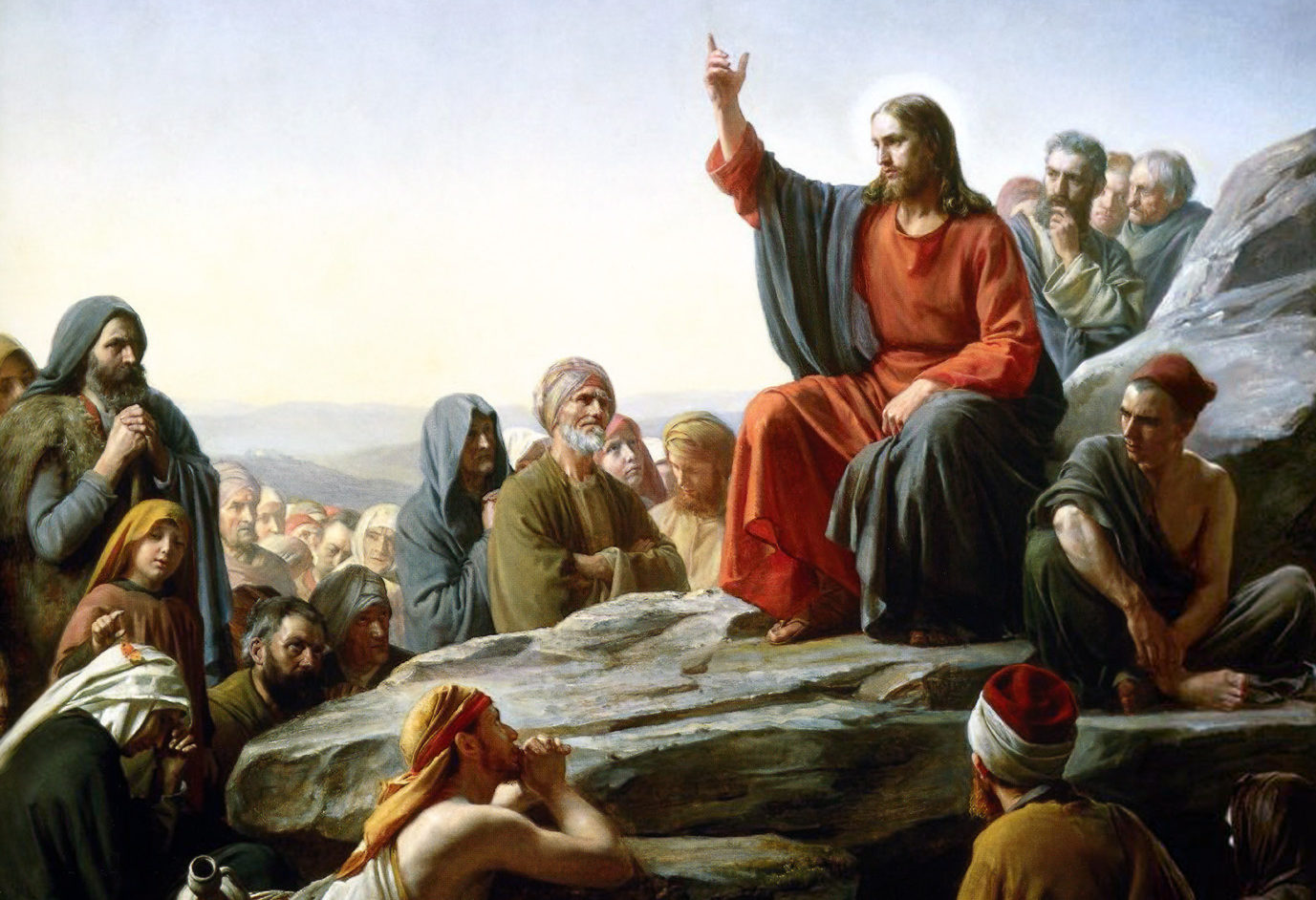
    Everyone thinks they know what Jesus looks like. He is the most painted figure in all of Western art, recognized everywhere as having long hair and a beard, a long robe with long sleeves (often white) and a mantle (often blue).

    Jesus is so familiar that he can be recognized on pancakes or pieces of toast.

    But did he really look like this? Probably not.

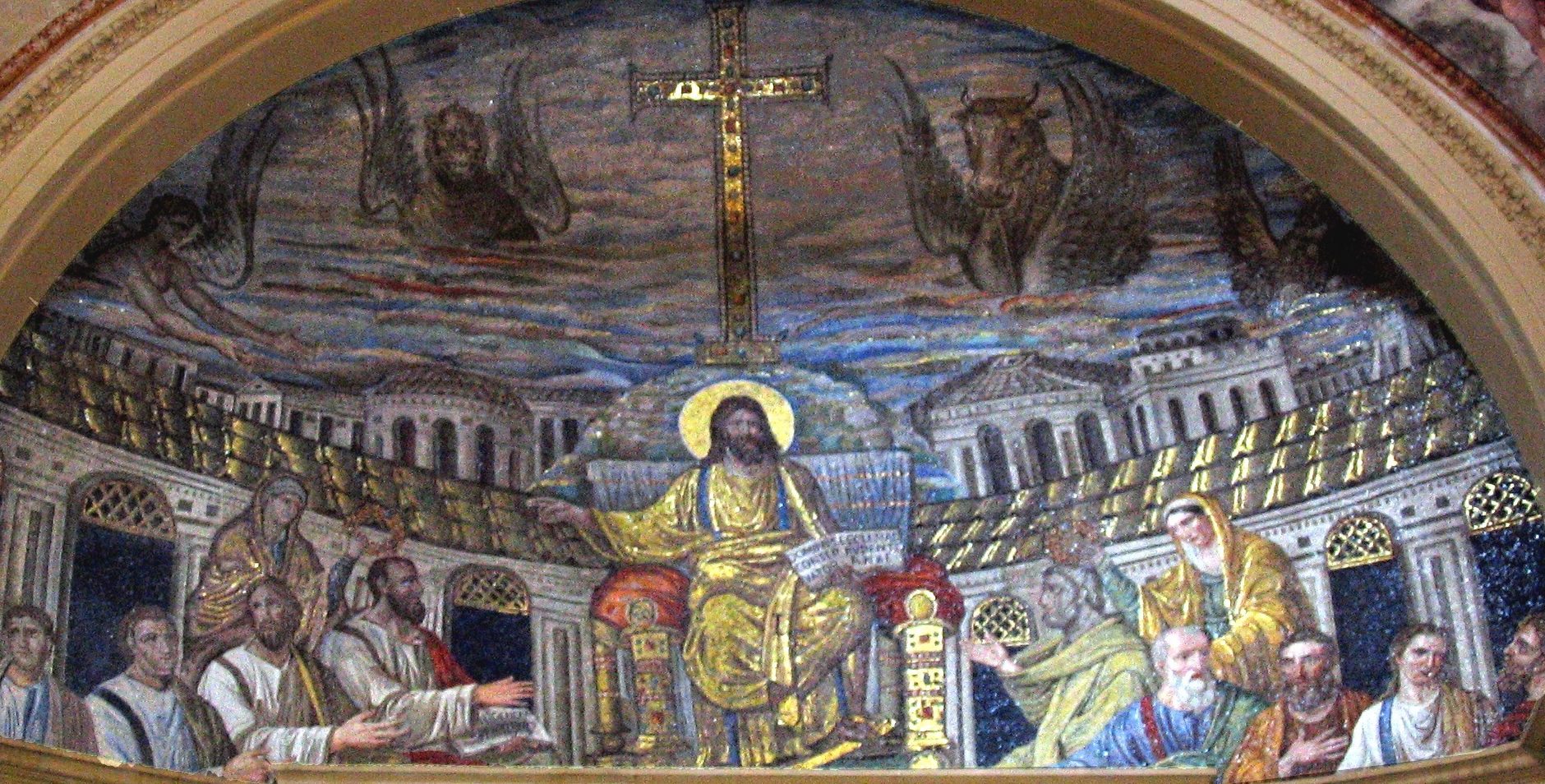
    In fact this familiar image of Jesus actually comes from the Byzantine era, from the 4th Century onwards, and Byzantine representations of Jesus were symbolic – they were all about meaning, not historical accuracy. They were based on the image of an enthroned emperor, as we see in the altar mosaic of the Santa Pudenziana church in Rome (shown above).**

    The halo also comes from classical art – it was originally a feature of the sun god (Apollo, or Sol Invictus) but was added to Jesus’s head to show his heavenly nature. Jesus is dressed in a gold toga. He is the heavenly ruler of all the world, familiar from the famous statue of long-haired and bearded Olympian Zeus on a throne – a statue so well-known that the Roman Emperor Augustus had a copy of himself made in the same style (without the godly long hair and beard).

    Byzantine artists, looking to show Christ’s heavenly rule as cosmic King, invented him as a younger version of Zeus. What has happened over time is that this visualisation of heavenly Christ – today sometimes remade along hippie lines – has become our standard model of the early Jesus.

    So what did Jesus really look like? Let’s go from head to toe.

    1. Hair and beard

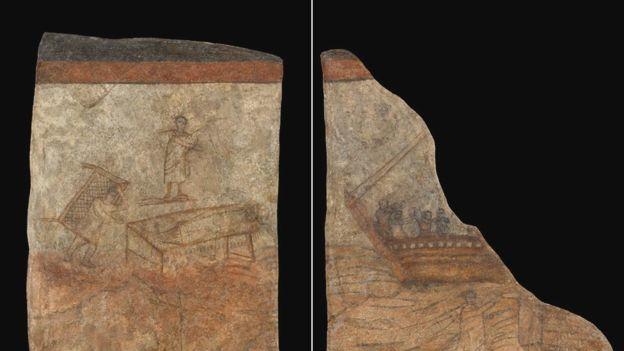
    When early Christians were not showing Christ as heavenly ruler, they showed Jesus as an actual man like any other: beardless and short-haired. The earliest surviving paintings of Jesus, from the church at the ruined city of Dura-Europos on the Euphrates (dating from first half of the 3rd Century AD), looks like this:


    But perhaps, as a kind of wandering sage, Jesus would have had a beard, for the simple reason that he did not go to barbers. General scruffiness and a beard were thought to differentiate a philosopher (who was thinking of higher things) from everyone else. The Stoic philosopher Epictetus considered it “appropriate according to Nature”.

    Otherwise, in the 1st Century Graeco-Roman world, being clean-shaven and short-haired was considered absolutely essential. A great mane of luxuriant hair and a beard was a godly feature, not replicated in male fashion. Even a philosopher kept his hair fairly short.

    A beard was not distinctive of being a Jew in antiquity. In fact, one of the problems for oppressors of Jews at different times was identifying them when they looked like everyone else (a point made in the book of Maccabees). However, images of Jewish men on Judaea Capta coins, issued by Rome after the capture of Jerusalem in 70AD, indicate captive men who are bearded. So Jesus, as a philosopher with the “natural” look, might well have had a short beard, but his hair was probably not very long.

    If he had had even slightly long hair, we would expect some reaction. Jewish men who had unkempt beards and were slightly long-haired were immediately identifiable as men who had taken a Nazirite vow. This meant they would dedicate themselves to God for a period of time, not drink wine or cut their hair – and at the end of this period they would shave their heads in a special ceremony in the temple in Jerusalem (as described in Acts chapter 21, verse 24).

    But Jesus did not keep a Nazirite vow, because he is often found drinking wine – his critics accuse him of drinking far, far too much of it (Matthew chapter 11, verse 19). If he had had long hair, and looked like a Nazirite, we would expect some comment on the discrepancy between how he appeared and what he was doing – the problem would be that he was drinking wine at all.

    2. Clothing

    At the time of Jesus, wealthy men donned long robes for special occasions, to show off their high status in public. In one of Jesus’s teachings, he says, “Beware of the scribes, who desire to walk in long robes (stolai), and to have salutations in the marketplaces, and have the most important seats in the synagogues and the places of honour at banquets” (Mark chapter 12, verses 38-39).

    The sayings of Jesus are generally considered the more accurate parts of the Gospels, so from this we can assume that Jesus really did not wear such robes.

    Overall a man in Jesus’s world would wear a knee-length tunic, a chiton, and a woman an ankle-length one, and if you swapped these around it was a statement. Thus, in the 2nd Century Acts of Paul and Thecla, when Thecla, a woman, dons a short (male) tunic it is a bit of a shock. These tunics would often have coloured bands running from the shoulder to the hem and could be woven as one piece.
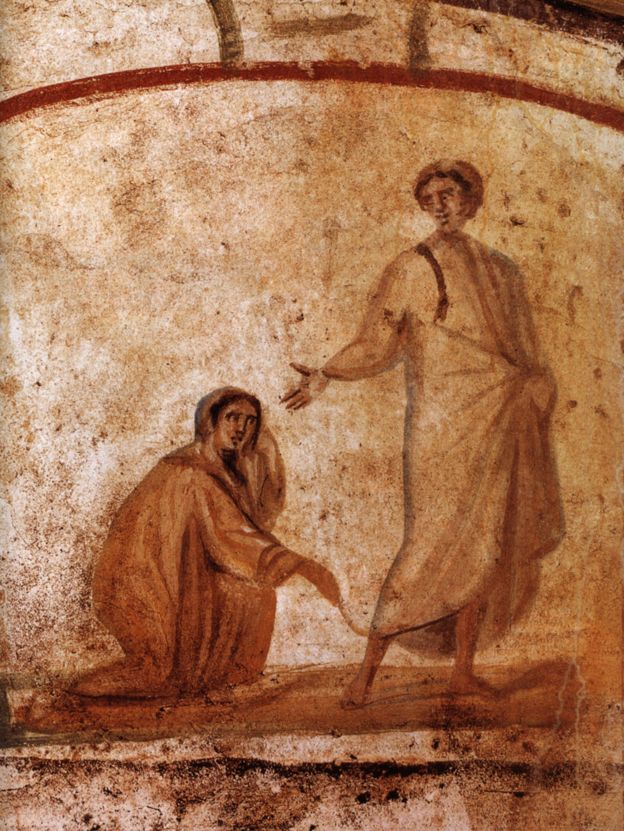
    On top of the tunic you would wear a mantle, a himation, and we know that Jesus wore one of these because this is what a woman touched when she wanted to be healed by him (see, for example, Mark chapter 5, verse 27). A mantle was a large piece of woollen material, though it was not very thick and for warmth you would want to wear two.

    A himation, which could be worn in various ways, like a wrap, would hang down past the knees and could completely cover the short tunic. (Certain ascetic philosophers even wore a large himation without the tunic, leaving their upper right torso bare, but that is another story.) The image at right depicts Jesus and a woman touching his mantle (Image courtesy of WIKI COMMONS).

    Power and prestige were indicated by the quality, size and colour of these mantles. Purple and certain types of blue indicated grandeur and esteem. These were royal colours because the dyes used to make them were very rare and expensive.

    But colours could also indicate something else. The historian Josephus describes the Zealots (a Jewish group who wanted to push the Romans out of Judaea) as a bunch of murderous transvestites who donned “dyed mantles” – chlanidia – indicating that they were women’s wear. This suggests that real men, unless they were of the highest status, should wear undyed clothing.

    Jesus did not wear white, however. This was distinctive, requiring bleaching or chalking, and in Judaea it was associated with a group called the Essenes – who followed a strict interpretation of Jewish law. The difference between Jesus’s clothing and bright, white clothing, is described in Mark chapter 9, when three apostles accompany Jesus to a mountain to pray and he begins to radiate light. Mark recounts that Jesus’s himatia (in the plural the word may mean “clothing” or “clothes” rather than specifically “mantles”) began “glistening, intensely white, as no fuller on earth could bleach them”. Before his transfiguration, therefore, Jesus is presented by Mark as an ordinary man, wearing ordinary clothes, in this case undyed wool.

    We are told more about Jesus’s clothing during his execution, when the Roman soldiers divide his himatia (in this case the word probably refers to two mantles) into four shares (see John chapter 19, verse 23). One of these was probably a tallith, or Jewish prayer shawl. This mantle with tassels (tzitzith) is specifically referred to by Jesus in Matthew chapter 23, verse 5. This was a lightweight himation, traditionally made of undyed creamy-coloured woollen material, and it probably had some kind of an indigo stripe or threading.

    3. Feet

    On his feet, Jesus would have worn sandals. Everyone wore sandals. In the desert caves close to the Dead Sea and Masada, sandals from the time of Jesus have come to light, so we can see exactly what they were like. They were very simple, with the soles made of thick pieces of leather sewn together, and the upper parts made of straps of leather going through the toes.

    4. Features

    And what about Jesus’s facial features? They were Jewish. That Jesus was a Jew (or Judaean) is certain in that it is found repeated in diverse literature, including in the letters of Paul. And, as the Letter to the Hebrews states: “It is clear that our Lord was descended from Judah.” So how do we imagine a Jew at this time, a man “about 30 years of age when he began,” according to Luke chapter 3?

    In 2001 forensic anthropologist Richard Neave created a model of a Galilean man for a BBC documentary, Son of God, working on the basis of an actual skull found in the region (image at right). He did not claim it was Jesus’s face. It was simply meant to prompt people to consider Jesus as being a man of his time and place, since we are never told he looked distinctive.

    Whatever some artists may imagine, Jesus is unlikely to have had blue eyes. He would have had brown eyes and black hair, and olive-brown skin like other Jews of the Middle East.

    For all that may be done with modelling on ancient bones, I think the closest correspondence to what Jesus really looked like is found in the depiction of Moses on the walls of the 3rd Century synagogue of Dura-Europos, since it shows how a Jewish sage was imagined in the Graeco-Roman world. Moses is imagined in undyed clothing, and in fact his one mantle is a tallith, since in the Dura image of Moses parting the Red Sea one can see tassels (tzitzith) at the corners. At any rate, this image is far more correct as a basis for imagining the historical Jesus than the adaptations of the Byzantine Jesus that have become standard: he’s short-haired and with a slight beard, and he’s wearing a short tunic, with short sleeves, and a himation.

    Moses appears to be wearing a tunic with blue bands, as well as a tallith (as a mantle) with blue decoration – in both cases the blue would probably have been created by dying with indigo. Here is the image most likely representative of what Jesus really looked like:

    Jesus looks like

    #  #  #

    Joan Taylor is the author of “What Did Jesus Look Like?”, available on amazon.com. In 1995 she won an Irene Levi-Sala Award in Israel’s archaeology, for the book version of her PhD thesis, Christians and the Holy Places (Oxford: Clarendon, 1993, rev. 2003). In 1996-7 she was Visiting Lecturer and Research Associate in Women’s Studies in New Testament at Harvard Divinity School, a position she held in association with a Fulbright Award. She has also been Honorary Research Fellow in the Departments of History and Jewish Studies at University College London. She has taught at King’s College London since 2009.

    **Photo by Sixtus, digitally enhanced, from Wikipedia